‘Doing the right thing’ and ‘being fair’ are virtues I aspire to, and this has been true much of my life, though I look at other people’s situations with kinder eyes now, now that I’m older. I could be harsh in my youth when I perceived failure in these areas.
This was an especial problem with my eating disorder. The behaviours it demanded led to me breaking my moral code in all kinds of ways.
The conflict between the behaviours I engaged in with bulimia and my beliefs around things like food waste and shoplifting contributed to my feelings of self-loathing, and this only made the eating disorder worse.
“See?” it could say. “You are a horrible person.”
I was in conflict with my ethics every time I binged and purged, and the guilt of the breach made a repeat that much more likely. I didn’t have much grace for my pathologies, back in the day.
To be human is to be imperfectly aspirational, but it took me a long time to accept that fact. I considered the perfection of the self and of the task necessary for me to even tolerate myself, and this was true for decades.
The joy of the eating disorder is that you’re encouraged to consider yourself a failure on multiple fronts – I was abandoning my values, and I still wasn’t thin or perfect. What a loser.
Being judgmental and critical of oneself also negatively impacts the relationships you have with other people. You’re not easier on other people than you are on yourself – you apply that hammer evenly across the board, mistaken perceptions of otherwise notwithstanding.
The pursuit of perfection is something one works to let go of in recovery. “Do your best” is a kinder and more productive philosophy – rigidity ruins much, and perfectionism is nothing if not rigid.
You can’t give to people what you don’t have. Can you extend grace to the world when pursuing a lifestyle in which it is so completely lacking?
I do hate rhetorical questions.
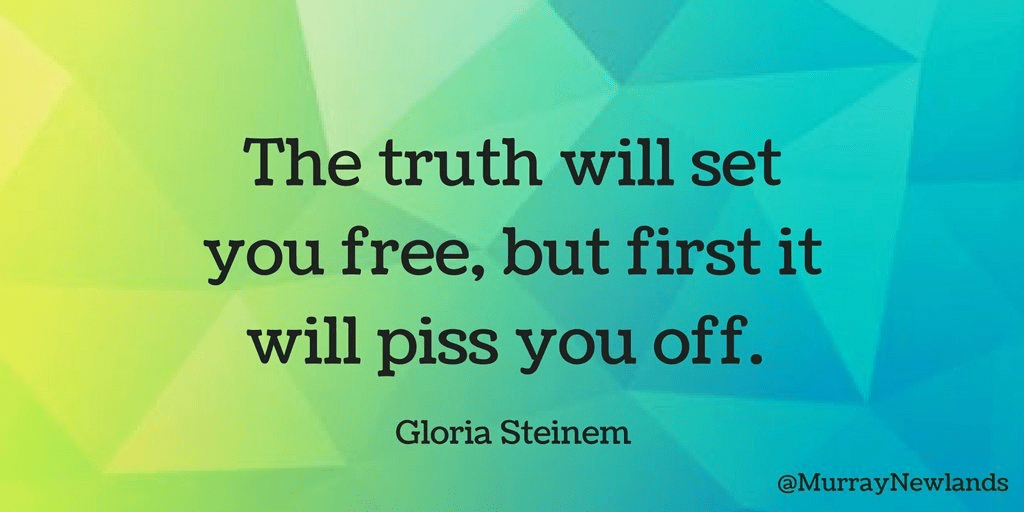
“The truth shall set you free, but first it shall piss you off.” Truer words about recovery were never said.
I still pursue fairness and the right thing, but I try to be more balanced these days. I search for situational understanding. I try to extend grace. I work on tolerance and acceptance of differences. There are, however, limits beyond which I won’t bend.
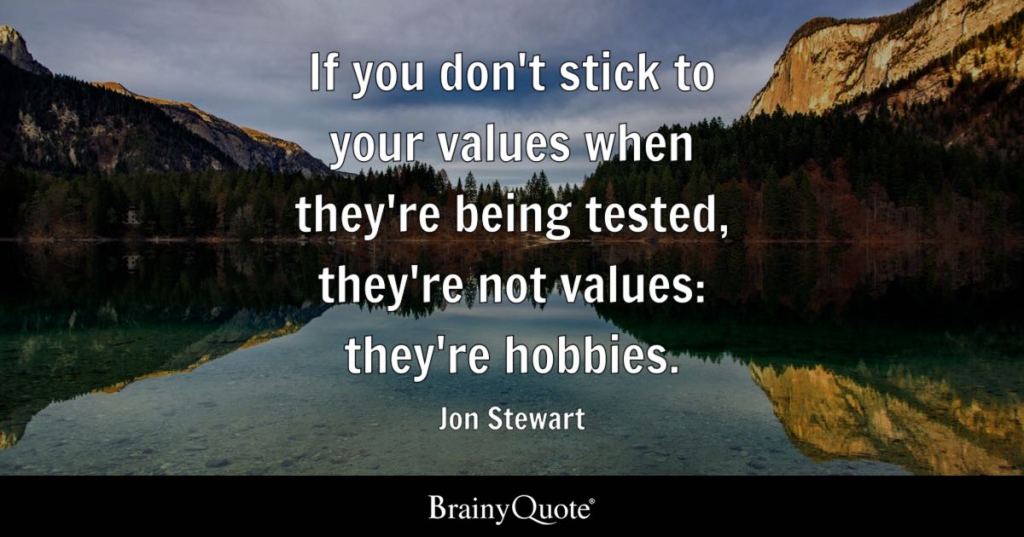
What is it that Jon Stewart said – “If you don’t stick to your values when they’re being tested, they’re not values, they’re hobbies.” We can agree to disagree only until we can’t.
I’ve never considered the ethical positions I hold a subject of debate. They’re simply correct.
I’ve also never really been one for hobbies, unless we’re counting reading.
There is much grey in the world when it comes to judging the actions of others, far more than I realized when I was younger and arguing with fellow students about it. We can and do shade almost every behaviour, and the degree to which we’re willing to do so reflects the biases of our societies.
For instance…
Killing other people is bad, except in those various circumstances and situations for which we’ve decided killing other people is a legitimate, necessary, or even celebrated choice.
Hitting other people is wrong, of course, unless you find yourself in a defensive position, or you’re doing it for money and entertainment, or it’s a child you made.
Lying is wrong and shouldn’t be tolerated, unless important people do it, in which case, lying should be excused. Truth is an ethical requirement only for the powerless, it seems. “The truth is what I tell you” is a too-common refrain from those at the top these days.
Not everything, however, is subjective.
I believe that there are moral and ethical absolutes that exist as a consequence of the human condition. Deviations from these norms don’t mean the rules have changed; it means that for some people, adherence to ethics and moral values isn’t a priority.
Many religious and philosophical pursuits have similar core beliefs about how people should live their lives, even as the language varies somewhat across the fields and faiths. We mostly come to the same conclusions about the rules and beliefs that good people and functional societies hold.
Our social problems, therefore, aren’t a result of a lack of moralistic cohesion when it comes to points of view; they’re due instead to an increasing lack of compliance. We’re okay when it comes to ethical theory, but we do less well when it comes to execution. Far too many people are abandoning ethics and morality.
I think less of people who choose to live unethical lives. I don’t believe money excuses anything.
My rules are unexpressed – I haven’t written myself a constitution, though it’s an idea. They’re simply who I am. They show up when the appropriate situation demands their appearance. It’s a bit of a haphazard way to organize a philosophy, so excuse any errors and omissions you may note.
Do as you like, as long as it harms none. Remember death – we, and all those we love, are mortal and subject to slipping from this life without notice, so don’t waste time. Not much in life is in our control. You control what you think and do to some extent, but not much else in this world, so do a good job with the things under your auspices. Tread lightly. Leave the world a better place than it was when you found it. Care for the vulnerable, the weak, and the least of us. Be as truthful as kindness allows. Waste not, want not. Be good to nature. Stand up for the vulnerable. Stand fast against evil.*
*Evil is like pornography. You know it when you see it.


Wonderful post 🎸thanks for sharing🎸
LikeLiked by 2 people
Thank you 😊
LikeLike
I have never really taken the time to think about my own “constitution”–like you, my “rules” tend to rare up when confronted by situations that offend them. Here is my unhinged t-shirt sayings:
Do unto others–I’m big on fairness. Speak up–I do not tolerate bullies/abusers; particularly those who afflict themselves against animals, children, the elderly, and the disabled (including the mentally disabled). Do something today/now that your future self will thank you for. Say yes to “fun” things outside your comfort zone. Don’t take yourself too seriously. Work hard, play harder. Love fiercely. Give your time and energy to those who deserve it. Speak the compliments you think. Show grace and don’t hold grudges (though that does NOT mean not to learn from negative experiences and set boundaries accordingly). Share your knowledge–be a teacher. Fight fair against those you love. Take responsibility. Bathe regularly. There is no such thing as overdressed. Heels go with everything.
LikeLike
“Speak the compliments you think” is such an awesome one, especially with strangers. I’ve been trying to do it more of late – I read a blog about the random compliment, and was inspired.
I will have to source some stencils as well as a press, I see.
Heels go with everything, and so do kick-ass boots 😁
LikeLiked by 1 person
Oh, yes—high-heeled boots!!
LikeLiked by 1 person
We hear the importance of moral and ethical beliefs for both of you. We appreciate your articulation of them in particular.
We feel concerned that how society operates might deprive us of many opportunities to exercise our values, especially if we rely on the triggering of our values situationally (“They show up when the appropriate situation demands their appearance”; “my ‘rules’ tend to rare up when confronted by situations that offend them”).
We notice that capitalism creates separations, such between the production of goods like food and clothing and the purchase/consumption of them. For us, we worry that since we don’t see the shoes being made, we can’t easily nourish our values that they be made not by children and not in sweatshop/slavery conditions. And so our values might not get stimulated into action by routine transactions because we can’t perceive the dissonance with our values.
We fear that we are all (everyone in capitalist societies) regularly complicit—simply by buying most things—in the perpetration of atrocities we would all denounce if they were visible to us.
We have tried recently to start educating ourself about supply chains and labor practices for clothing, though we haven’t purchased goods that way yet. We’re sticking to second-hand clothes for now.
Do you worry about these situations, too? If so, how do you live out your values when they’re not situationally triggered?
LikeLiked by 1 person
I also perceive the ethical problems with the current system, and I also struggle.
Capitalism perhaps once had a nodding acquaintance with ethics, but I suspect for too many, those days are long gone.
I read a story about the Arizona Iced Tea Company not too long ago. it’s costs 99 cents a tin to buy. It has always cost this. The owner/manufacturer was interviewed and said he didn’t see the need to raise prices. He could cover his expenses, pay his employees, and make a decent living – what more do you need?
Greed married capitalism a while back, and the results have been unfortunate.
In the eighties and nineties, it seems to me that we were more aware of corporate ethical violations. Boycott Royal Dutch Shell and Dole over apartheid. People spoke more with their wallets.
The more businesses got offshored into legislation-free economic zones, the worse things got for “employees” and the less we heard about poor working conditions. Why worry when everything got plentiful and cheap?
I also like second-hand clothing and goods for that reason – minimized demand of newer and more problematic items. I have companies I simply won’t buy from for various reasons – social and production ills like those at Hollister and Lululemon, for instance.
I also struggle with things that come from problematic political situations. Do you want your purchases to help a country that makes diminishing women a priority, for instance. I find buying local foods, goods, and crafts helps me feel better about likely working conditions and pay scales, but even there, you’ve no idea where they’re sourcing their inputs.
In a better world, we wouldn’t have to worry about things like child slave labour for our shoes and electronics. In our defense, producers and sellers work hard to hide their problematic ways.
I do the best I can, and I also donate to charities that work to improve conditions in developing nations, especially for women and vulnerable populations.
There are some lines I wouldn’t cross no matter what. I won’t buy a Tesla – that’s been true for a long time for me. I don’t buy from Kardashians. I embrace a boycott that aligns with my morals and values with ease.
Child slave labour is an especial heartbreak. It’s a blight across many industries, and not just overseas. It changed how I eat chocolate. Much child slave labour in food production.
LikeLiked by 1 person
Wow Michelle…this is heavy! Thanks for sharing 🙂. I especially endorse this line “We’re okay when it comes to ethical theory, but we do less well when it comes to execution. Far too many people are abandoning ethics and morality.” Yep, we know when something’s wrong…especially blatantly so…but some of us bury our heads and do it anyway.
LikeLiked by 1 person
Agreed. Too many of us are turning ostrich as the going gets tough.
LikeLiked by 1 person