Self-criticism
I’m a professional when it comes to pointing out my flaws and mistakes. I rarely give myself grace. I have little mercy when it comes to slips and missteps. You’d think I was running evaluations for the Olympic committee.
I have more grace for other people. Other people are expected to be human, to make mistakes, and to be imperfect. These are lessons I still struggle with. It’s hard to pay attention to behaviours built into the bones.
Besides, one doesn’t generally correct other adults unless they’re about to march into traffic. It’s considered rude. I’m not sure why constantly talking negatively to ourselves isn’t.
I’m working on being nicer to myself, but it’s a challenge. Is it strange that self-kindness is a hard for so many of us?
I’ve been thinking about adding a reminder tattoo, perhaps on my inner arm though that location stings some. The details about what tattoo I’d get are still fuzzy. I’m not sure if I want script or symbolism.
On the bright side, delaying things lets me continue to trash-talk myself without checks.
I like to think of myself as a special snowflake, unique in all the universe. We all like to think of ourselves in this way, and it’s mostly true. There are, however, commonalities. What’s true for me is true for many.
Far too many of us are engaging in nasty personal nitpicking.
Why do we treat ourselves in ways that would receive pushback if the target was anyone else?
Negative self-talk
Nearly everyone talks negatively to themselves, and their self-talk is unique and specific. There are category commonalities – many of us have similar experiences and pressures – but our brains make it personal with inside knowledge. The barbs are specific, and they sting.
We all have weak spots and specific vulnerabilities. Mine are mostly related to concerns about my body, face, and appearance. An eating disorder’s grip is strong and long-lasting. I wonder if it uses Crazy or Gorilla Glue?
The pathology of an eating disorder aligns nicely with society’s demands for physical perfection, especially from women. My unfortunate behaviour choices get reinforced by society regularly. They even get props – everyone loves skinny.
The pursuit of skinny is big money. The personal improvement industry – diet, exercise, and beauty – moves billions of dollars through world economies. What’s a harsh inner critic, and a generation of self-hatred in the face of capitalistic success?
Self-criticism is perhaps a consumer capitalism feature. People buy fewer things when they’re happy and content. Misery and dissatisfaction hit the mall. Or open the Amazon app. And shopping does silence self-criticism for a minute. At least until you check out the new furniture on the neighbour’s deck.
Comparative and internalized criticisms
Self-criticism can be divided into two broad categories, comparative self-criticism, and internalized self-criticism.
The former, comparative criticism, relates to your relationships. People who struggle with comparative self-criticism base their sense of self and their self-esteem on the (perceived) valuation of others.
You are, therefore, only as good as other people’s opinions. It’s a mindset that’s very concerned with status and rankings. A perceived negative evaluation is met with hostility because it attacks one’s place in the world. Unfortunately, it’s also believed and stimulates the “need” for correction.
The latter, internalized self-criticism, is my default setting though I’m always happy to drag myself down using comparison.
Internalized criticism arises when your opinion about yourself is negative regardless of comparison. You evaluate the self as insufficient all on its own. You are not enough. Even successes are viewed negatively: how can they be otherwise when the self is fundamentally flawed?
A problematic core belief wrecks much, and sustained improvement and change are unlikely unless it’s addressed.
Categories of criticism
Our insides and outsides
I enjoy hating on my body, though perhaps “enjoy” is the wrong word. Perhaps more accurate is that I’m used to it. It’s a habitual behaviour. I’ve hated my body for most of my life. I’ve hated myself. I’m comfortable here. But “comfortable” doesn’t mean “good.”
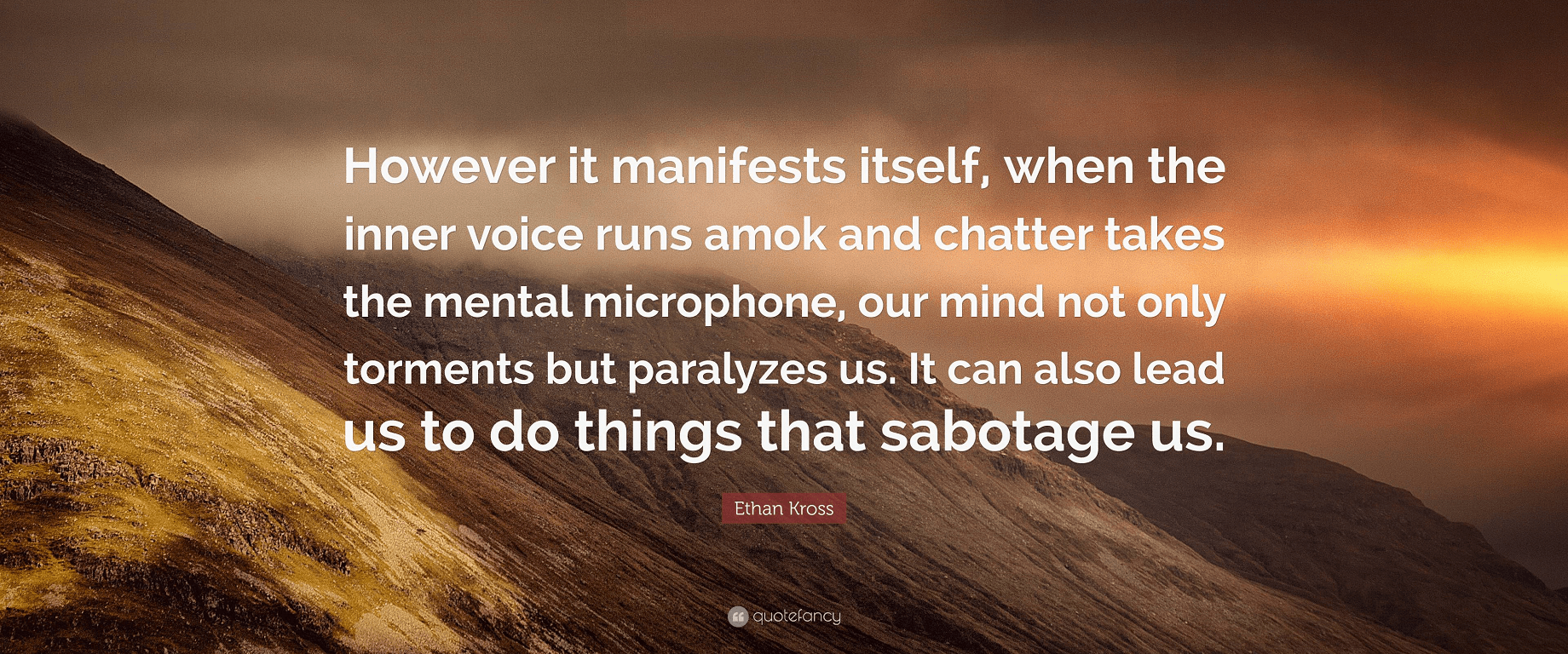
It’s hard having a nasty, sotto voce running in the background all the time. It’s awful listening to a critical inside voice saying critical things day in and day out. It’s tiring to hate on yourself.
It would be nice if the inside voice came with a muzzle feature or duct tape. Even my cheap stereo has a mute button.
Hating on the body is not unique to me, however. That behaviour is carried out by millions at ostensibly non-pathological levels. Concern about weight and appearance is number one on many people’s minds.
If we’re not acceptable, we risk rejection, and that one gets us right in our instincts.
Primal fears like rejection are good things to poke at if you’re in the business of selling. Concerns about how we look cover a wide purchasing landscape.
Everything else
It’s too bad that corrective shopping tweaks another popular area of self-criticism: you don’t have enough money. We tie any number of externalities to our fundamental worth as humans. It’s a mistake.
Work, professional development, and financial health; family, friends, and relationships; our health and appearance; and our past, present, and future. These are our hot buttons. These are the subjects that our inner critic likes to bludgeon us with most.
Thank goodness it’s a small list.
Our inside voices question and criticize with a nasty amount of glee. Some charges hurt more than others. I’m vulnerable to attacks about my appearance, but less so regarding attacks on my smarts.
It’s too bad our brains live with us, and learn our weaknesses and sore spots.
Quieting the critic
One of the things I like best about wine is its ability to shut down the brain. After a glass or two, my inside critics find they have better things to do with their time. I like it when they have an elsewhere to be.
I bet they go dancing. That happens here when there’s Pinot Grigio.
Unfortunately, avoidance doesn’t work as a long-term solution. You can persist with bad choices, but you won’t enjoy how a commitment to maladaptive coping shakes out.
Our inner critic is driven by any number of things. Our family and personal histories, our current life situation, and our nature all play a part.
No need to throw up hands in despair, however. A nasty inner voice isn’t an inevitability. Self-criticism is a learned behaviour – and we practice – and as such, it can be changed.
You don’t have to accept the things you think. Thoughts aren’t true just because you generate them. I quite enjoy talking back to myself. I’ve become spunky.
Step one is always to start
When you become aware of what you’re thinking, when you become aware of critical and negative thoughts, stop the train and change directions. Push back. Ask yourself questions about your thoughts and feelings. Negative thoughts are built on smoke and sand: they collapse when you apply pressure.
My inside voice finds evidence very distressing indeed.
In the early days of practicing, it felt strange having a back-and-forth with myself. I got used to it, however, and even came to enjoy pushing back. It’s nice when you reject the hurtful, garbage thoughts your brain is pushing on you. It makes me feel like I’m winning.
I do wonder about the brain’s apparent contrary nature at times. It seems to forget we’re in this together. Counsellors can also help unravel knotty thinking.
Journalling can help when it comes to breaking the habits of negative self-talk and self-criticism. Writing things down helps you notice patterns, either content – for me it’s weight – or timing – my inside voice gets mean in November.
Being aware of patterns helps you make plans in advance. It can help you stop criticisms before they start. It was looking back through old journals that made me realize late fall is an annual problem.
Practice self-compassion. Have grace. Treat yourself like you’re someone you like. I’m not sure why this one is so hard. Why do we like to kick when someone’s down? [1]

What to do, what to do
- Challenge negative thoughts
- Journal your thoughts and feelings
- Work with a counsellor to pinpoint and correct problematic thinking
- Plan in advance for times that are more challenging
- Practice self-compassion. “Self-Compassion” by Kristin Neff is an excellent book, and there’s also an online community
[1] My brain loves an earworm. It can pull one from nearly any turn of phrase. About halfway through writing this essay, my brain started signing “Inner Ninja” every time I typed out ‘inner critic.” To be honest, having an inner ninja would not be the worst thing. Nunchaku that negativity.


 From Famine to Feast
Why is it so easy to give others grace, but not for ourselves. Just crazy. I’m not much of a tatoo guy, but maybe I need to take your idea. For me, it would be as simple as the word “Grace.” But knowing my own self-criticism, I’d probably need to get a bull underneath the word to remind myself not to be stubborn and to take my own advice. Ha, ha.
LikeLiked by 1 person
Right? The follow-through is always the hard bit. But “grace” is a favourite sentiment.
LikeLiked by 1 person
Agreed…why are we always our own worst critic.
LikeLiked by 2 people
Too much practice, and nobody likes to waste a skill 😉
LikeLike
Perhaps we were all just born to be bullies, and the easiest targets are ourselves. 🤷🏼♀️It’s unfortunate, but at least I don’t trash talk myself 100% of the time.
Like you, there are parts of me that I am truly confident in and I am my own inner cheer squad. So few people TRULY cheer me that I’ve gotten in the habit of cheering myself—if you ever see me silently smiling while not engaged in any conversation or reacting to my environment, it’s likely that I’m pleased with myself and mentally giving myself props.
Pre-COVID, I was in the habit of blurting out my complimentary thoughts to whomever I was having them about—it was often strangers, and they visually blossomed at my simple and genuine appreciation or praise. I certainly don’t do it as oftennas I used to, and I need to correct that—it makes them feel good, and forces me to focus on the good in others instead of the undesirable in myself.
LikeLiked by 1 person
I think it’s wonderful to compliment people. It does bring happiness. COVID hurt much, and the tenseness of our interactions is one of those things.
LikeLike
I think the thought that we’re born to be bullies is an interesting one. Our inside thoughts often seem to bear that up.
I love knowing that your Mona Lisa moments mean good things ❤️
LikeLike
Dang it. I wrote out a LONG comment…in my browser. Hit post, and it disappeared. 😩 Is it in your comments to be moderated?
LikeLiked by 1 person
I blame Google and programs that clear the cache lol. I hate finding out I’ve been signed out of things. I don’t remember my passwords 😂
LikeLiked by 1 person
Nearly all of my passwords are once assigned from the system as a “strong password” and I just save them to my password manager, so I don’t know any of my passwords. It’s so frustrating!
LikeLiked by 1 person
Some of the worst offenders, like Apple and my internet provider, I give horrible passwords to. Something nice and insulting.
LikeLiked by 1 person
🤣🤣🤣 I used to do that when I created my own passwords.
LikeLiked by 1 person