I’ve always had an overdeveloped sense of fairness. I say “overdeveloped” because it’s a charge that’s been levelled at me on more than one occasion.
Overdeveloped. Aggressive. Judgmental. Rigid. We do like to throw adjectives at people when we disagree with them.
I don’t know that the adjectives are entirely incorrect. I can be outspoken when it comes to my ethical convictions. I can be firm when it comes to discussing my ethical practices. Does that mean my ethics are overdeveloped? [i]
I also don’t know that I’m going to change things. I might work on moderating what people perceive as aggression. I don’t want to be perceived in that way. It’s a behaviour that mostly shows up when I’m anxious or frightened, and since anxiety is a horse of a different colour (from my perspective, not my recipients), a different solution is required. When it comes to anxiety, I practice.
I practice in advance of situations, anticipating possible interactions, and I remind myself that I’m a worthy and competent human being. I remind myself that other people probably aren’t trying to cause me distress. That usually helps me stay firm without the shift to fierce. But it doesn’t always happen if I don’t prep in advance, and it’s shockingly easy to forget to use solutions that work.
It’s not fair
Children have a solid and inherent sense of fairness, as anyone who has spent time with them can attest. They understand the concept almost before they have words to express themselves in relation to it. Fairness is an ethic that comes hardwired in us it seems, for all that we start to circumvent it as adults.
It’s not our fault. Our society is geared towards competition and winning, and when those are the most prioritized outcomes, fairness is a virtue that’s easy to abandon.
Of course, fairness isn’t the only ethic that gets abandoned in the pursuit of winning.
“Winning” is an interesting goal, especially for adults not involved in a soccer game. Win what, exactly? “The one who dies with the most toys wins.”
I’ve always liked that quote. There’s another, similar one that I’m fond of as well: “Eat right, exercise, die anyway.”
But I digress.
Ethics and morals
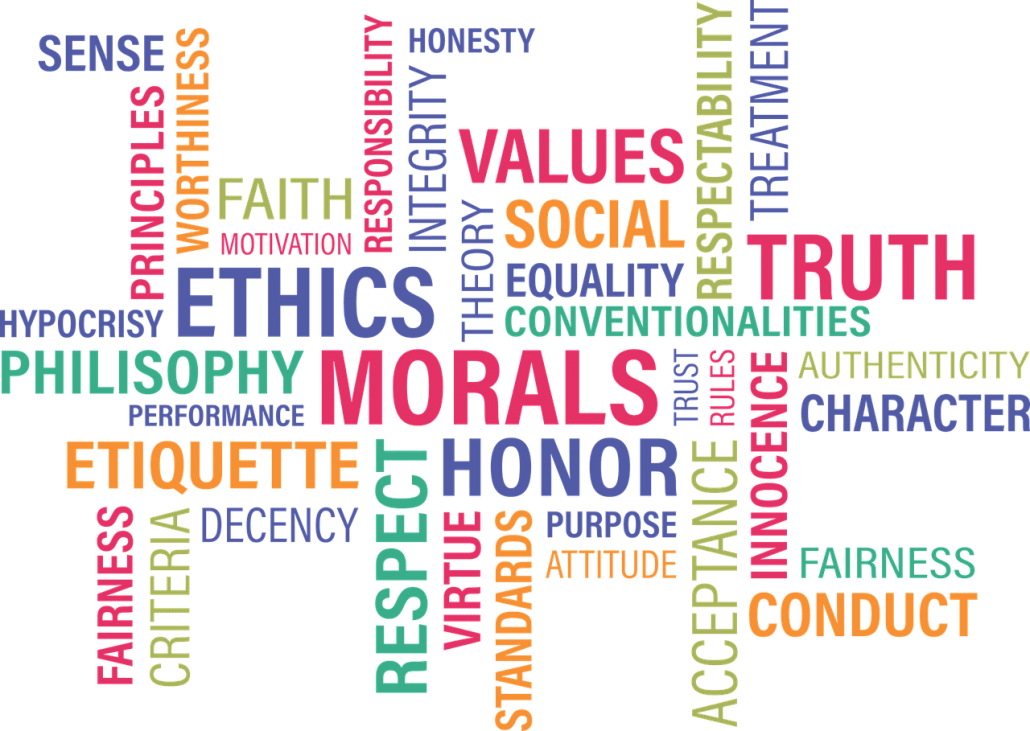
The word “ethics” is derived from the Greek “ethos,” meaning “way of living.” Ethics is the area of philosophy that’s concerned with human behaviour; with how we live and act towards one another, and how we interact with our environment. We’re engaging with ethics when we talk about concepts like freedom, responsibility, and justice.
We derive both moral principles and societal structures from our ethical values. Ethics are therefore both personal and societal. Ethics can also be field-specific. There are extensive writings covering medical ethics, legal ethics, business ethics – insert cheap joke here – and the like. There are also broader fields of study such as behavioural ethics.
But what exactly are these referenced moral principles that guide our behaviours, and where do they come from?
Ethics are morals are ethics is a less-than-helpful circular definition. Sometimes, people also throw values into the mix – ethics are morals are values are ethics – but the morals-and-values distinction appears to be one of language, not kind. Pick the term you like best. I prefer morals. “Values” feels looser.
When you put your morals and ethics together, you get a belief system, sometimes referred to as an ethical regime. Your ethical regime is what informs your points of view. Our points of view tend to be complementary and mutually supportive. One could try to build a worldview based on opposing values, but it would fail, and likely cause cognitive dissonance.
It would be like trying to combine caring for others with unfettered capitalism.
Morals and values
Morals are the beliefs one has about what is and is not acceptable to them regarding the topic at hand. There are personal and societal morals, and morals can be absolute or relative, though that understanding only comes with age and experience. Rigidity is almost never a good look for us.
The acquisition of our value systems is both passive and active. Children learn by family instruction and by existing in the system, but they also learn via direct action and lived experience.
Just as people have ethical regimes, so to do societies. However, the gap between ideals and reality remains a wide one in most developed countries. In the war between ethics and money, money usually wins.
I learned from family and society, but also from reading. And the things I learned about character, ethics, and personal values from the books I read have informed my character significantly. We are nature and nurture.
Much of who I am was built by books.
Reading, ideas, and character
I started reading at a young age. I was read to from the get-go – my mother loved literature – so I was already reading when I hit kindergarten. Reading was my favourite thing to do, and I did it constantly. I’d bring home nearly unmanageable stacks of books from the library each visit. I’d read ahead in school texts, and then read books I’d brought during lesson times as I waited for the class to catch up.
The best gifts were books.
I was the kid who got told to “put down that book and go outside to play.”
Boomer parents really pushed the outside.
I read both fiction and non, and a cross-section of genres from the former though I tended to avoid graphic horror and serial killers (still do). It’s hard to get those images out of your brain. I loved adventure stories like Nancy Drew and The Amazing Five. I liked stories about girls my age, like Harriet the Spy and Judy Blume everything.
But I leaned most strongly towards science fiction and fantasy, and the ethical lessons contained therein aren’t subtle at all. Susan Cooper, C.S. Lewis, Margaret Atwood, Douglas Adams, Arthur C. Clarke, Madeleine L’Engle, Ursula K. Le Guin and more all had important things to say about human beings, life, and the nature of the world.
Part of my value system was built from these stories. Do the right thing, even when it sucks. Stand up, even when you’d rather not. Don’t back down when you know you’re in the right, even when it’s hard. [ii]
I prefer to make the ethically correct choice, and I’m not shy about sharing what I think that should be when it comes to contentious topics. It’s these interactions that often see an accusation of “aggressive” levelled in my direction.
I wonder if they call men responding in a passionate fashion “aggressive” as well?
Speak truth to values
I’ve never been good at silence in the face of wrongdoing. I wouldn’t call it a flaw, though it has cost me. Sometimes, there are consequences to doing the right thing.
Once upon a time, I didn’t know that was going to be a thing. Who chooses the wrong side on purpose? Once upon a time, I assumed the wrong choices were made because of a lack of information. It isn’t. There’s disagreement between people when it comes to morals and ethics.
I tend to categorize those who disagree with me as wrong. I suppose that’s arrogant. I’ve heard that before too.
In this life, we encounter people who possess damaged moralities – belief systems built on diminishing others and causing them harm, for instance – and it’s important to stand up in the face of it. Silence isn’t golden. Silence isn’t benign. Silence is silence.
It’s not always okay to let people be.
I don’t think I’m rigid. I’m not wedded to the idea of the one true way, nor am I blind to situational exceptions. But there are right things and wrong things, and we’ve gotten too flexible about that when it comes to adult behaviour.
We allow too much space for wiggle room in the name of money, or because we like the bad actors. [iii]
People we like will sometimes do bad things. That doesn’t mean we look away. Instead, it’s up to us to respond appropriately.
Wrong is wrong
If a thing is wrong, then it’s wrong, and it remains wrong regardless of spin. For some behaviours, the consequences should be lifelong. That doesn’t mean there can’t be forgiveness, or moving forward. It means consequences. Things are different for the perpetrators in the after.
Not everything deserves a blank slate.
For instance, I believe being a convicted sexual offender should disqualify you from holding public office. I think violating another human being in that way indicates a lack of character. And we ostensibly value character in our leaders.
Public offices should be held by those whose character we can respect. We should be staffing these jobs with the best of the best. And contrary to claims one sometimes hears, good character isn’t subjective. You can’t do and say bad things, and still be a good person.
We’re our words and our actions, not our aspirations.
| An Incomplete List of Ethical Values | ||
| Honest | Fairness | Accountability |
| Gratitude | Collaborative | Discipline |
| Altruism | Integrity | Respect |
| Compassion | Humility | Charitable |
| Kindness | Loyalty | Courage |
| Moderation | Grace | Justice |

[i]My bulimia required me to circumvent or ignore many of my personal ethics. It’s greedy. It’s wasteful. I engaged in theft and deception. I lied. My eating disorder kept me in constant conflict with my values. I think that’s another reason for what people perceive as “rigidity.” I forced myself to ignore them in the past to great personal cost.
[ii]Who knows how things break down: let’s call it 70-30 books and family.
[iii]I can be a little rigid when it comes to my environment, but that’s a need for organization and a calm environment, not an ethical position that harms other people.
 From Famine to Feast
I agree with you! You are not alone in your thoughts!
LikeLiked by 1 person
Thank you, for reading and commenting.
LikeLike
Thanks 👍
LikeLiked by 1 person
You go, bitch! 😉 Another name I’m called pretty regularly for unapologetically holding strong opinions, judgments, ethics, morals, and values. #NoRegrets
LikeLiked by 1 person
Beauty in total control, honey. I remember that one. Do you remember the Meredith Brooks song?
I’m glad you have no regrets 💖
LikeLiked by 1 person
Of course I do—I sing it pretty regularly…it’s a fave!
LikeLiked by 1 person
Now that I say that, I think of heard you sing it 😊♥️
LikeLiked by 1 person
Really appreciate this perspective, you are not alone in it!
LikeLiked by 1 person
Ciao, buona serata a tutti voi, come vanno le cose spero bene!
LikeLiked by 2 people