
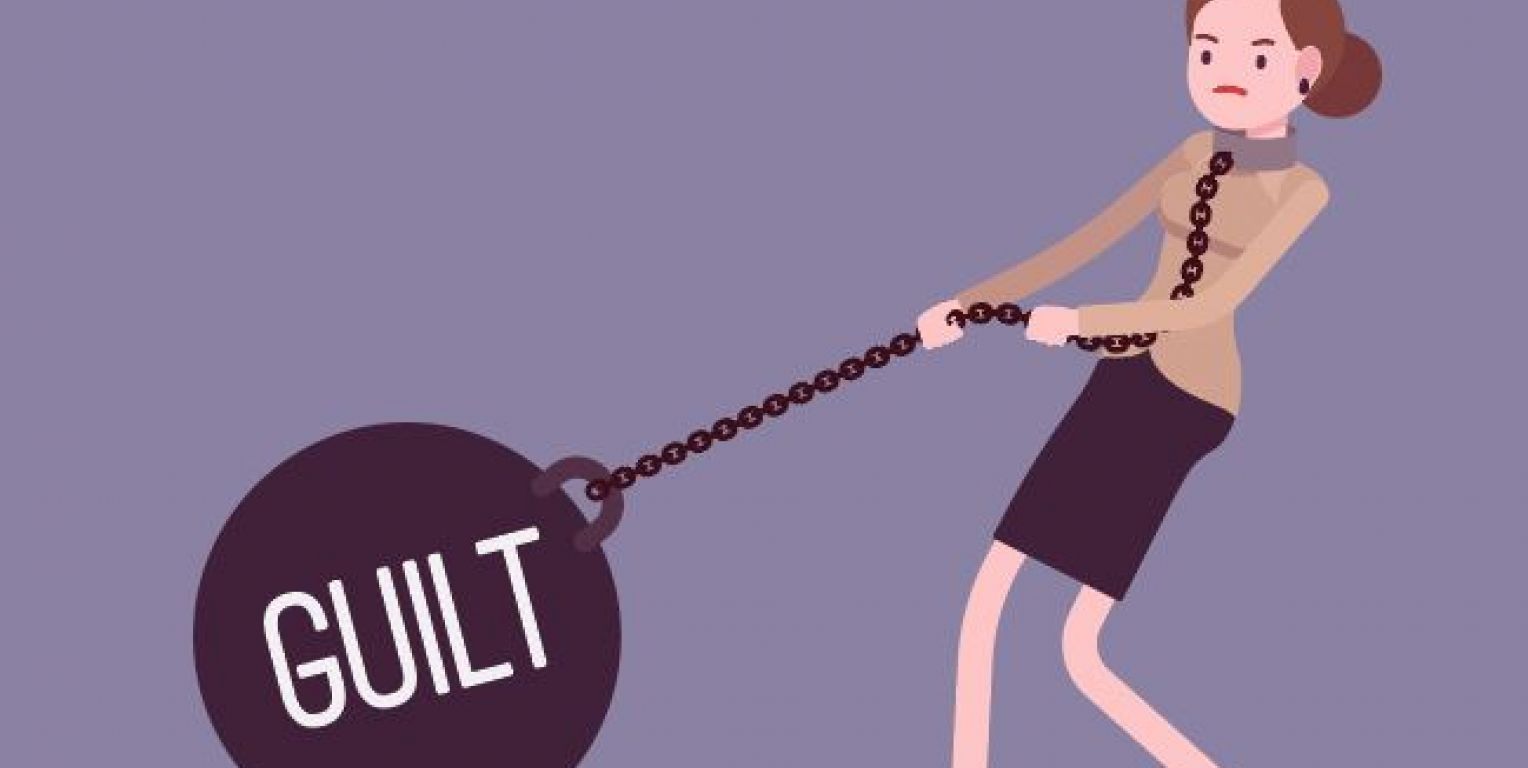
How do you feel about guilt? I’m not a fan, but it’s useful when it’s not overly abundant. Too bad too much is so often.
What’s guilt got to do with it?
I call myself the Queen of Guilt though I’m aware there are pretenders to the throne. Guilt is among the most ubiquitous of our emotions. We start feeling guilty young and we keep at it our whole lives.
I suspect we’re hardwired for guilt. Some of us are better at letting go, but we all wear hair shirts some of the time. [i]
Guilt’s not always a negative – the threat of feeling guilty keeps us more honest than we might otherwise be, and that helps us all rub along on a more even keel. We’re less about being good than we are about being comfortable.
Things we’re inclined to feel bad about include behaviours that could be destructive (personally and societally) if they ran unchecked. Personal relationships couldn’t exist without checks on our behaviour and those checks mostly exist because we don’t like feeling built.
I’m good at guilt. I can feel guilty about almost anything, whether it’s my fault or not. I feel guilty over things I have no connection to. I feel guilty about things not in my control.
I feel guilt over things I didn’t do but considered doing. Contemplation guilt.
Guilt has longevity: why is it true of the uncomfortable emotions so often? I still feel guilty about the hydrangea I pulled up three or four years ago now. I had vague ideas about potting it, but the root structure was bigger than I anticipated, so into the compost it went. [ii]
Yes, I get inanimate guilt. That’s why getting rid of stuff is a challenge. What if those old plates feel bad about being discarded?
I can even summon guilt about things I did when I was still in single digits.
There’s a quote from the 2005 movie “Serenity” that I’ve always liked:
It isn’t mine. The memory, it isn’t mine. And I shouldn’t have to carry it. (River Tam)
Why do we carry guilt that isn’t ours? Why don’t we feel the guilt we should?
What is guilt anyway?
We’re creatures of language. We use words all the time. Some of them we even understand. About many, however, we’re a little vague:
I can’t define it, but I know what it means.
The survey says, no. If you can’t define something it isn’t yours, even if you can use it correctly in a sentence. That just means you’ve got the gist. But if you can’t define it, you can’t teach it, and dissemination is the true knowledge test.
Watch one, do one, teach one. It’s as true of philosophy as it is of mechanics. Surface knowledge is another thing that gives me guilt.
We feel guilty, the verb, but guilt is also a noun. So is “gilt,” but we’re not talking gold leaf, picture frames, and bad decorating choices today.
For those waiting in breathless anticipation, guilt is the person, place, or thing – remember those old grade school lessons – the crime, offence, or behaviour – that leads to the bad feelings. We feel guilty when we do what we ought not to. That’s not a flaw, it’s an asset. It’s what keeps us rolling along together in a relatively smooth fashion.
To behave in an antisocial fashion would bring up feelings the majority of us dislike.
Are we good people or are we pain-averse?
What if you don’t feel guilty? Not in a sociopathic sense – I assume you feel guilt some of the time. What if guilt isn’t the feeling you’re experiencing? We feel a great many things. We’re not always the best at labelling them.
What if guilt is like so many other words, coopted and corrupted? What if feeling guilty is just the new, “I feel fat?” [iii]
Feelings are hard, not least because we have so many of them. English is a big language and we’re not taught enough of the descriptor words. We teach kids about happy, sad, scared, and mad. We expand on these ideas post-kindergarten somewhat, but not as much as we could especially considering how many words and feelings are out there. [iv]
For most of us, our vocabularies are insufficient when it comes to describing our feelings. Even if we know the words, we have to dig deep –we tend not to use what’s not hovering on the tip of the brain. We’re energy-conserving that way. [v]
How was your day?
Good.
How was your day?
Creative, fruitful, constructive, helpful, productive, educational, frustrating, repetitive…
Sometimes, the feeling is guilt. Sometimes, the guilt is appropriate and earned. I can be unkind.
The ickiness of guilt seems an appropriate consequence for nastiness and thoughtlessness. We should feel bad when we do bad things or cause harm.
Perhaps the problem isn’t in feeling guilty, but in feeling guilty forever. Perhaps the problem with guilt is our tendency towards longevity.
We feel guilty when we violate our own rules for behaviour. We feel guilty when we violate society’s rules for behaviour, though much of that’s training and some of those feelings should be discarded, especially depending on one’s location.
I’m not a big fan of instilled guilt.
We feel guilty when we act in ways that are contrary to who we want to be as a person. We feel guilty when we sacrifice our integrity. I cringe especially hard over memories of the cheap shot. Nothing like causing deliberate pain to bring on guilt. Too bad it’s well-deserved. That’s the hardest kind of guilt to get rid of.
Society judges our behaviour as well, the criminal and the day-to-day. Guilt is doled out in buckets, officially and by the mob. However when it comes at us from others we call it condemnation.
The marriage of social media and mob rule is not a good thing.
Negative behaviours that are severe enough to cause guilt are rarely consequence-free though who gets what, and when, and for how long varies significantly. At least society’s punishments come with ostensible term limits. We don’t think to install those on the sentences we bring down on ourselves. [vi]
I suppose that’s why I still cringe over things I did in my twenties. We often treat personal failures like they’re punishable forever, most especially when the sins are venal. We should start applying statutes of limitations personally.
Letting go of guilt isn’t as easy as it seems in books and films. They often seem to manage it over the course of a musical number. I don’t find the people in my life breaking into song and dance too often. It’s a shame – grocery shopping would be more exciting.
I also don’t like change. Perhaps that’s another reason why I’m attached to my hair shirts. I’m used to them. What would I wear instead?
You’d think we’d embrace behaviours that make things better, but that’s not how we roll most of the time. In the battle between change and routine, routine often takes the day despite how miserable it’s making us.
We prefer things to remain the same even if they’re awful. A negative offshoot of our biological preference for homeostasis, perhaps.
I know I’m about to start thinking about something I’d rather not when my chest gets tight. It’s the first tell. The muscles of my ribs tighten and constrict in anticipation of anxiety. Counterintuitive because it’s deep breathing and deliberate relaxation that keep anxiety at bay, but there you go: people are nothing but contrariness.
These days I’m better at letting the tension rise and fall, but once upon a time, body tension was my signal to flee. I didn’t believe I could withstand the feelings that were coming next. Memories and guilt seemed too big to manage. I didn’t believe I could get through them to the other side.
I didn’t believe there was another side. I thought it would all be too big, too much. There were too many bad feelings. There was too much guilt. I would never survive.
Resistance, it turns out, is the exact wrong choice. What you resist, persists.
Recovery loves a good soundbite. I’d mock the tendency more, but the sayings are often correct. You can’t let go of something you refuse to face. You can’t release the guilt until you look at it in the face, and address it at the source.
I hate living through ugly memories again (unlike other people who so obviously enjoy the experience). But it’s suppression and avoidance that keep memories hot and allow unresolved guilt to persist.
I don’t want to deal with it. I would much prefer to jettison the baggage unopened. That’s not an option. You can’t let the luggage go until you poke around and inspect what’s inside.
I hate dealing with things done to me, and I hate relieving the times when I was, if not evil, then definitely not my best self. Plus, it’s not one-and-done most of the time. You have to revisit, forgive, and let go a few times before it takes.
On the bright side, not having lingering guilt over rejecting that guy in grade nine feels just spiffy.
Good guilt
We’re works in progress. We’re not perfect, individually or generationally. We’re getting better though. We improve a little with each generation. I think.
That’s the good side of guilt. It can motivate. It can inspire us to change. We learn. We grow. We evolve. We do better.
We do. We tend to guilt, but we also tend to inertia. Guilt is part of the machinery that helps us get it done, and done better than before.
Without guilt we’d repeat the most basic boondoggles ad nauseam – nothing would incentivize us to change or do things differently. We respond quickly to personal discomfort, and guilt brings that in spades.
You only ask a woman if she’s pregnant once.
Guilt is like most things human, complicated. Too little of it and we stagnate, too much of it and we stall. You want to be motivated to change and improve, not to be paralyzed by self-disgust and self-criticism.
If it seems that things for you are leaning more towards the latter, it might be time to review.
Most of us aren’t that bad, despite the dark thoughts that occasionally dog our existence.
Header credit: Psychology Today.
[i] “Hairshirt” isn’t a metaphor. It was a literal penitential garment woven from the rough hair of goats or camels.
[ii]My house backs onto greenspace. There’s a strip of forest there. Non-food items like grass or murdered hydrangeas end up there. Sometimes they grow like the iris tubers I dumped out back. Not so the hydrangea.
[iii] “I feel fat” is the common refrain of eating disorder sufferers. It’s also crept into the general vernacular. Fat is not a feeling. Fat is a state of being, or perhaps the butter for your toast. It’s shorthand for, “I feel miserable, broken distressed, and a whole bunch of other things that I can’t communicate.”
[iv] Other languages are more descriptive, but most modern societies don’t embrace regular and wholesale discussions about feelings.
[v] Politically correct for “lazy.”
[vi]Society’s punishments come with term limits, but do we treat released prisoners as though they now have a clean slate?
[vii]Is it possible to read those words without hearing Elsa sing the Frozen version in your head?
 From Famine to Feast
Great post greatly you told about aspect of guilt
LikeLike
I am a Queen of Guilt, too 🤭
LikeLiked by 1 person
Too bad it doesn’t come with a royal purse.
LikeLiked by 1 person
Guilt avoidance is the big reason I’m consistently way too busy tackling to-dos. I try to avoid the inevitable guilt of not accomplishing enough on the list, but I fail nearly every day. I wonder what it’s like for people who are happily and perpetually “lazy.” #Goalz
Everything would be so much more fun if spontaneous dancing and song routinely occurred everywhere!
LikeLiked by 2 people
I wonder about those people too. I bet they sleep easy.
I’m down with life as a musical. Especially if the animals start to talk. Except my cat. She knows too much.
LikeLiked by 1 person
I wish I could sleep easy.
My cat knows all the things too, but vice versa.
LikeLiked by 1 person
Thought provoking post on eating disorder and recovery. Glad you’re feeling better. Yes, guilt tends to bring us down but the right amount of guilt helps us make changes. There’s a thin line that defines which side of it we’re on I guess.
LikeLiked by 1 person
Thanks for reading and commenting.
I’ve had this debate before – I don’t think guilt is motivating. Ditto shame. I think it’s one of those lies we tell ourselves.
LikeLiked by 1 person
Very true
LikeLiked by 1 person