“Gifted” is mostly practice
I find it odd when people use the phrase “gifted,” because what they’re labelling as “talent” is most often the result of hard work. Talent is nice, sure, but without training in the area of interest, it’s also fairly useless.
The “talented” label also denies the work people put in.
This is not to say that there isn’t a very tiny portion of the population that’s gifted in some area or other. But as that number is statistically insignificant, I’ll focus on the rest of us.
For instance, I’ve played piano for nearly five decades. I don’t play as much as I once did, but I like to sit down at the keys at least a couple of times a week. Mostly because I love playing, but also because I think it’s good for my arthritic hands and middle-aged brain.
I wish I had five dollars for every person who said they wished they had my gift with music. I’m not preternaturally gifted in this sphere. In any sphere, if we’re being honest, though perhaps fifty-six will be the year my magic comes in? What they see as a musical gift is the result of decades of work.

This is also true with smart people, another area of training for which I receive compliments, she said with a humble brag. While it’s true that there’s a range of intelligence that ends with geniuses, most people fall within the category of “average.” Even smart people lie in that section of the bell curve. “Smart” is more than born-with ability. Like musical chops, it’s also the result of work.
Smart people practice. They read. They listen. They learn. They think. They stretch their brains just as I stretch my fingers at the keys. You can stretch your instincts as well. Escape rooms are good in this regard. Or holiday dinners with family. Those kinds of occasions have my instincts for survival firing on all cylinders.
And to think, some enjoy the holiday meal.
Instinct is a skill
Instinct, like talent, is a little bit of factory specification with work and training on top.
Some of our instincts come hardwired: we’re born with ones that will help us survive. For instance, we seek out food almost immediately after we’re born, and we arrive cute to circumvent the parental rejection that would be fatal.
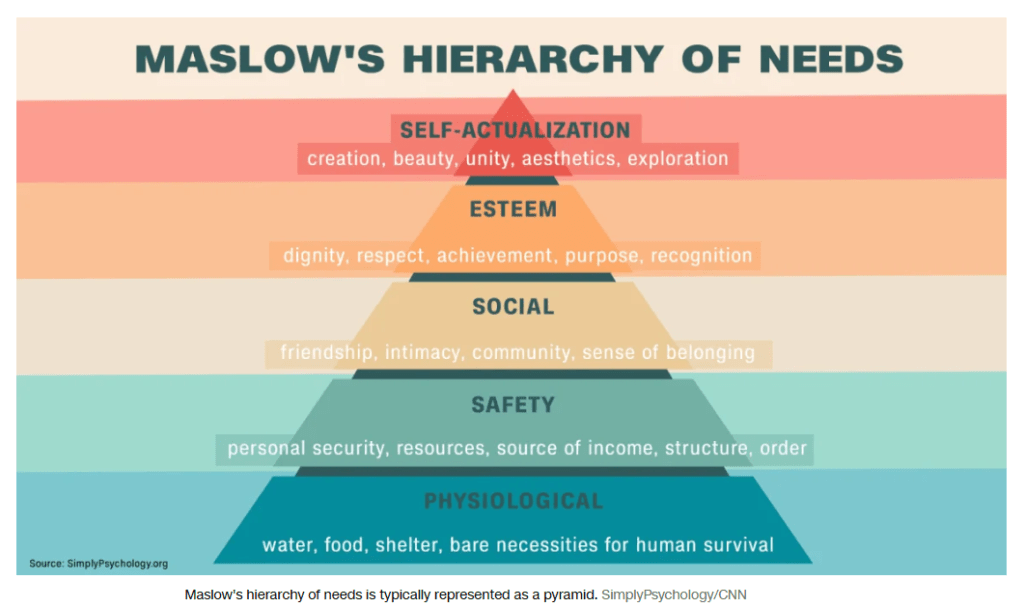
Think ‘Maslow’s Hierarchy of Needs’ when looking to identify human instincts: we need food, shelter, and connection to thrive and survive. These are the things our instincts drive us to secure. The list gets refined and more expansive as we age.
We also have instinctive fears. We’re afraid of the dark, of the water, of predators, of fire, and of abandonment. This is not a finite list of fears, just some of the ones we arrive with. They make sense. These fears are also about surviving. Some of the ones we add to the list later, not so much. The odds of my encountering outsized ants are low.
Our brains aren’t always the best at differentiating between real and imaginary when it comes to fear.
We outgrow some of our early, instinctive fears as we age and learn. The more we know about a thing, and the more expert we become, and so, the less it frightens us.
Others of us hold onto fears even when we know more. Or is running up the stairs from the basement because of dark and stair monsters just a “me” thing? Do you hold on to childhood fears despite logic?
Good instincts
I have good instincts when I pay attention. I’m getting better at doing that, at believing the things my instincts and thoughts are telling me. Instincts improve with age and experience, and I trust mine more each time they’re proven correct. I wonder if this is something all adults enjoy? There has to be some benefit to the collagen loss.
I’m especially good at sussing out who’ll be a problem in a group of people. I can tell who has anger issues, who likes to be in charge (and who gets pissy when they’re not), and who’s going to be contentious just for the hell of it. I can spot angry aggression at two hundred metres out.
It’s more to a radar I’ve developed with exposure and practice. Some instincts may come hardwired, but they also develop with exposure, practice, and training, and I’ve had more than my share of aggressive people.
I’d prefer to have good instincts about who has a big bag of money they’d like to share rather than who will be controlling, but so far, no joy.
Our instincts improve as we age because what we call instinct is actually a result of our thought processes. Subconscious thoughts, mostly, but still. And the older we get, the bigger the database our brain has to draw from. Instincts and intuition improve with experience.
We don’t refer to intuition and instincts as “thinking” because they happen quickly. Our brains are hot stuff. We perceive sensory stimuli in as little as fifty milliseconds or one-twentieth of a second. The entire cognitive cycle, including perception, conscious processing, and action selection, is estimated to take about a third of a second.
That’s why the space between seeing the spider and shrieking is tiny.
Instincts are fast
Our brain processes about eleven million bits of information every second, but the conscious mind can only handle forty to fifty bits per second. Phoebe Buffet was correct. We don’t know we know what we know. We often incorrectly attribute reasoned (subconscious) judgments to good guessing.
I’ve made some bad decisions and poor choices in my life. I used to say I had bad instincts when it came to people, places, and jobs. That’s untrue and unfair. The problems I encountered usually came about because I ignored my instincts. I didn’t trust or have faith in my conclusions. I didn’t have bad instincts. I had silenced ones. I didn’t want to rock the boat.
This is another argument for good boundaries. It’s hard to follow your instincts without them. I worried that trusting my instincts would hurt other people’s feelings. I had little resistance to other people’s demands without them, screaming intuition notwithstanding.
I pay more attention to my instincts these days, and it’s serving me well. As is often the case, I did better once I started trusting myself. This is as true of instinct as it is of boundaries and eating disorder recovery.
Though the absence of lottery instincts continues to irk.


 From Famine to Feast
Yes
LikeLiked by 1 person
::whine:: But I am special! 😉
I don’t know how many times I’ve corrected people when they say I have a talent or a gift. They are skills. I have skills—lots of them. Learning stuff and getting “smarter” (really, just more knowledgeable) is a lifelong hobby of mine. Yet another arena you and I both occupy.
Even “dumb” folks usually have one or more areas that they are super smart/advanced in—what you water grows. It ain’t rocket science.
LikeLiked by 1 person
Love your ability to interweave humor and story, Michelle. And I’m still chuckling about this, “Those kinds of occasions have my instincts for survival firing on all cylinders.”
Excellent point about instinct and practice. Boundaries are important!
LikeLiked by 1 person
Thank you. I’m always grateful when the humour shows through.
LikeLike
I really appreciate your insights on instinct and the concept of being “gifted.” It’s refreshing to see someone emphasize that skills are often cultivated through hard work and practice rather than mere talent.
Your experiences with music resonate with me; I too believe that it’s our dedication that truly shapes our abilities. The point you made about trusting our instincts is something I think about often. I’ve learned that the more I pay attention to my gut feelings, the more accurate they become over time. It’s so true that some instincts can get dulled or ignored, and recognizing that is key.
Your thoughts on intuition serving us well when we trust it align perfectly with my own experiences. I’m always working on balancing that trust with the wisdom learned from past mistakes. It’s fascinating how our brains process so much information so quickly, yet we often don’t acknowledge this ability.
Thanks for sharing your reflections! I look forward to hearing more of your thoughts on this.
LikeLiked by 1 person
Thank you for reading, and for leaving such a thoughtful comment. I very appreciate your thoughts and insights. Have a lovely day.
LikeLiked by 1 person