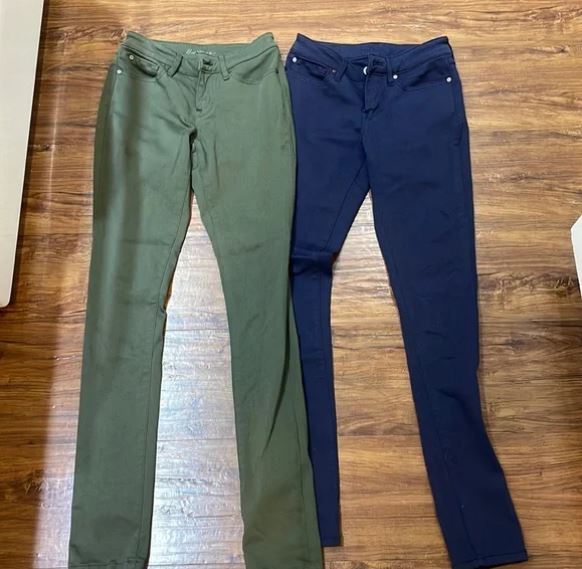
I’m wearing a pair of pants that are a little too tight, and in terms of eating disorder recovery, that’s a pretty epic win. [i]
That I’m wearing pants – not baggy jeans, track pants, or yoga leggings – is also a win. Pants were in the category of “clothing allowed when my body is perfect.” Until then, it was baggy bottoms – bonus points if it was ugly or slovenly, or tighter ones covered in tops that doubled as tunics. The important thing was to hide all the imperfections which for me, most of the time, was everything save my forearms. And my ears. [ii]
I’ve always liked my forearms, even after they ended up covered in scars, victims of an episode of extreme self-hatred slash soft suicide attempt. I still love them though they’re covered in tattoos now, and the fairy on the left forearm occasionally gives buyer’s remorse vibes.
Clothing can be a real problem when you have an eating disorder. The inside voice is loud and critical when it comes to clothing. You’re too fat to have nice stuff, and too hideous to wear it anyhow, and those thoughts play inside your head (along with other equally nasty ones) on permanent repeat. The word “grotesque” featured prominently in my inner dialogue.
The one true size
In addition to the moral value eating disorders assign to nice clothes and who’s entitled to wear those, there’s also the problem of sizes. Because there are correct sizes, and incorrect sizes and the number on the tag is how your worth as a human is determined. The smaller the number, the closer to perfect. Or so we’ve been sold. It’s not the best value scale – sizing is notoriously fickle across producers.
You may not have known about the correct size rule – or perhaps you do since disordered eating and body image issues affect more and more people in developed and developed nations. It’s a great distraction from attacks on our human rights and the problems caused by the concentration of wealth in a paltry few, but I digress.
The correct clothing size is always the one that’s smaller than the size you’re currently wearing. It’s a fluid definition; the size you’re wearing now can never be good enough. You can enjoy achieving a new, smaller size for a millisecond when you achieve it before the eating disorder points out a fatal physical flaw that still exists and must be corrected.
For me, it has always been my thighs. I did not have legs like my mother. She had legs like Whitney Houston – or Whitney had legs like my mother considering their respective birthdates. I have legs like my father, a shot from my maternal grandmother that burns my soul to this day.
She didn’t have long and lovely legs either – she topped out at five foot four. But she had a dab hand with a dig.
My legs are muscular. I suppose we could call them shapely, and even daring to type that hurts, so obviously there’s more work to do on body acceptance. My thighs are my weak spot, and an eating disorder is happy to capitalize on a weak spot.
Tight pants didn’t mean that I needed a different size or style – often a case for those of us with a curvier build: I’m an endomorph – remember those? – but that I was a failure as a human, and would need to correct things by dieting more and better, and exercising more and better. Tight-fitting pants led to punishing consequences. Changes were instant. No soup for you, and no breakfast either.
Self-care and slacks
I’ve not been doing my best at self-care since my mother died. In part, I think it’s because this feels like non-time, and so rules like daily showers and protein don’t apply.
We’ve not been able to have the memorial service yet – cancelled due to severe weather and now rescheduled, but still – so life feels like it’s in limbo. There’s no closure for this set of circumstances – the death – so I’m able to move on to the next which is, I suppose, learning to navigate a new reality.
Though grief is making me organize on a near constant basis. I feel an overwhelming urge to get rid of things which I’m resisting. This is not a good time to make big changes. I wonder if it’s reverse nesting? Death culling. Or perhaps it’s just that organization is my go-to in times of emotional distress. Feeling upset? Time to reorganize the t-shirts. Time to add more organizational baskets. I’ve changed my closet organization three times over the last two years.
The pants I put on today are navy. That’s also an evolution that happened as I’ve moved forward in recovery – pants that aren’t jeans and aren’t black. No white yet – baby steps – but I do own a pair in a houndstooth check. I don’t wear them very often yet, but I own them. The blue ones of today are a curvy, slim-fit skinny, and long enough that they cover my ankles, a frequent issue one has with pants when you’re five foot seven and a bit.
No one appreciates the struggle of the mildly tall woman. The pants and skirts and shorts are all just that little bit too short, and we’re not tall enough to hit the tall people stores. We don’t always want to wear dropped-crotch track pants, but how else are we supposed to get the bottoms near our ankles?
But I digress. Again.
It’s not me, it’s you
I was a bit tense putting them on – they read small when I held them up – but I needn’t have wasted the panic. They’re snug, but they didn’t require any major struggle. They fit tolerably, just a smidge on the confining side. They’re “lose five to seven pounds” too tight around the legs (for my comfort though many choose to wear their pants fitted this way. I prefer a looser experience. Excluding yoga pants. Though the waist on these is a good fit proving again that with clothing, it’s usually one or the other).
But I didn’t tell myself I was a horrible failure of a human being who deserved to die when I pulled them on and found them snug, and not doing that is relatively new to me. New enough that I still appreciate my inner harpy’s weakness and absence.
The above criticism is a sentence I’ve repeated more than once in my life when I failed by not fitting into my clothing (non-baggy underwear was also taken as a sign of failure) in the manner the eating disorder deemed I should. When it came to self-evaluation, according to the eating disorder the problem was me.
But I’ve not been going there of late, and even when the eating disorder tries, the effort is weak and easily subdued. I’m a little shocked I’m holding the line, to be honest.
The pants are snugger than I would like, but I didn’t get changed into something exceedingly unattractive as a punishment for my failure as a human being. Sure, I’m grieving and part of that grieving is a diet of mostly cheese, crackers, and chocolate with an occasional piece of fruit to shut my conscience up, but that’s no excuse for letting yourself go. That would’ve been the conversation once upon a time. These days, I encourage my inside voice to give myself a little bit of grace.
Your inside voice is a liar sometimes
The eating disorder thoughts are still there sometimes, circling around, seeking weakness. The sentiments show up, but they lack the heat and substance of historical attacks. They feel habitual, not personal, and thus, they’re easier to let go of.
I wore the pants shopping – I added a shirt before I left the house – and they’re still on now that I’m home. And the longer I have them on, the more I’m okay with the fit. My inside voice did suggest cutting back for a week or two, cancelling chocolate, and upping the amount of exercise I’m doing, just until these pants bag a little bit – did I mention they have Lycra – but, I let those thoughts float away.
Ignoring my brother when I was younger may not have stopped him teasing me, but it’s a different result entirely when you ignore negative and non-productive thoughts.
That is perhaps the part of recovery I like the most, my ever-improving ability to let things go. Eating disorders are about compulsive rigidity – at least mine was – and compulsive rigidity’s almost never a good time.
Letting rigid judgment go feels a lot like freedom.
Clothing as clothing and not as a size-based value statement on my worth as a human being is a shift of epic proportions. It’s especially amazing to me that it’s occurring without a perfect body. Because a perfect body was the precondition of anything good according to my eating disorder, and that included recovery. You can get help when you get thin.
Eating disorders are such liars.
[i] Side note: for “pants,” read slacks. All are obviously pants. Regional linguistic differences are interesting.
[ii] I’ve liked my ears historically, and I like them now, but ears grow as you age. That’s depressing to me. I don’t love my dad’s ears.
 From Famine to Feast
Those are cute pants. I bet you look great. How we see ourselves is so strange. I read an article today where the author said “Feelings report to you. They are not your boss.” I love that.
I am so saf to hear about your Mom’s death. I obviously have some reading to do. Sending hugs. You cared for her well. I know you invested a lot of yourself in that.
LikeLiked by 3 people
That is a great quote. I’m going to try to remember it though I’m not the best with quotes and jokes.
Thank you. I appreciate that.
LikeLiked by 1 person
Congrats on the tight pants 😊.
LikeLiked by 1 person
Thank you. I do like them 💖
LikeLiked by 1 person
A pretty epic win – that’s good, Michelle. Your ability to describe how the eating disorder is present but not able to land anything is so good. I’m sorry you haven’t been able to schedule your mom’s service. Such a great step to be able to celebrate our dearly departed. I hope it’s scheduled soon.
LikeLiked by 2 people
Thank you. It’s rescheduled now, for this Friday, and the weather looks like nothing but rain, so people will be able to make it.
LikeLiked by 1 person
<3 <3 <3
LikeLiked by 1 person
Lovely pants, I personally love the greenish shade more. An eye opening post, at the end of the day being healthy is what counts the most. Everything else will follow. We’re harsh on ourselves, more so than the other do, at times. It’s time we start loving and accepting ourselves.
LikeLiked by 1 person
We are harsh with ourselves; it’s a shame we learn that behavior.
I’m glad you found it interesting. I found the picture online, they are my pants, but I never saw the green ones. I’d have had those in a hot second as well.
LikeLiked by 1 person
“Letting rigid judgment go feels a lot like freedom.” We feel much hope and joy reading this
Does having an empty nest influence how you relate to self?
LikeLiked by 1 person
That’s an interesting question. I suppose the answer would be, it’s complicated.
I find other people difficult at times, not because of what they do, but because I go into performance mode. Everything is about the other people in my orbit. It’s hard not to do this, though I work on it, so being away from people can be a respite.
The tendency to prioritize and cater to others can lead to harm. Do you find you do it?
LikeLiked by 1 person
We are worried about being judged and criticized, and so we are on guard and get exhausted around people we know. We really feel scared of people often and so then avoid them. We don’t perform much anymore (one of us does lol), more like hide/withdraw/avoid
LikeLiked by 1 person
I relate to that. I find other people very fatiguing at times. I’m on guard with most people as well. I think it’s because, with most people, I don’t fully trust.
Lol.
I also find the preparation to being around people tiring – practicing, debating fears with the brain, debating the strange scenarios my brain comes up with – sometimes not doing it is easier.
LikeLiked by 1 person
We also find ease in not going, most of the time
We notice that we are more resourced early in the day, so we rarely choose to participate with people in the evening. Recently we went to two post-funeral gatherings in the evening: one (bigger group gathering) we felt lonely and scared and were defensive. The other, four of us for dinner at a restaurant, felt easier
LikeLiked by 1 person
That’s true for me as well, though in the summer months, when there’s more light, I do better for longer in the day.
I’m sorry there has been so much recent loss.
LikeLiked by 1 person
Summer light definitely helps our mood!! Though probs not our resourcefulness. We like sunsets and it’s hella easier to stay awake for 5pm sunset than 10pm hahaha. We like the lights off and blinds open at night but no one we live with likes that. They get too tired
The recent loss of friends affects us daily. Thank you for seeing us.
This funeral was the parent of high school bff. We have grown apart. This wasn’t a deeply felt loss for us. We went to meet our need to support. We are probs similar age group to you based on kids getting older and moms passing from lung cancer, so it seems like funerals are increasing. We just didn’t expect our friends to choose death. Those stats probably won’t show up in pandemic death tolls and we wonder about that timing
LikeLiked by 1 person
I like the curtains and blinds closed in the evenings once it’s dark, but that’s because I like to dance around. I do like the bedroom blind open in winter.
I agree. I’m 54. Many of my parents’ friends have died.
The pandemic was hard on people, and people who depended on resources struggled to get them.
I’m sorry. I know A’s death has been very hard ♥️
I wasn’t not expecting what happened. The choice made me very sad, but in mental illness circles, that choice is more frequent than in the general population. I’m not casual or callused about it, but I’m used to it happening. Which is horrible.
LikeLiked by 1 person
If we dance (actually, it’s “shaking”—a strategy we use to get body to synch with hyperventilating body), we angle ourselves away from the windows intentionally. We like to see outside to look for danger/safety
We like the thought of your dancing because to us dancing meets needs for movement and self-expression
We are 52 (not rubbing that in—or are we…)
Ashley was the first friend we loved to make that choice. She knew we loved her, and that feels comforting to bigs and mediums (our teens and olders inside)
Littles miss and don’t get comforted very effectively. Ugh!!!!!
Not going to end a message on this note, for both our sake’s
We did consider squids, too, but don’t know if they have 8 appendages or live in houses in BC. Please enlighten us hahahaha 💕
LikeLike
Isn’t it funny how self-conscious we become and remain. I’m not even sure people can really see in, or care. But here we are, hiding.
I appreciate being able to see. It’s why I like doors open in my house.
To be honest, so far the fifties have been a blur. I turned fifty in 2019, and 2020 on has been a little chaotic for everyone.
I’m sorry it’s hard to comfort littles. Death is a difficult concept. All littles understand is absence.
Squid have ten appendages. I used to really enjoy eating calamari, but I find that my empathetic nature makes eating many foods hard. Disney et al does us no favour by making animals adorable either.
Though I do love a good burger. Are you a carnivore – I apologize if you mentioned it and I’ve forgotten.
LikeLiked by 1 person
we eat meat, yes. Don’t recall mentioning that before. We are the household cook. Have been since first married.
We care about animals and plants and feel upset if we waste food. Our community composts and so we compost food scraps
We like nature a lot and feel connection with plays outdoors, and animals. We love birds and lots of different kinds of bees and milkweeds and lots of trees.
Been very depressed today. Gonna go cook dinner: burgers, ironically 💕
LikeLiked by 1 person
I’m sorry the day was hard – the groundhog didn’t see its shadow, so spring is ostensibly coming. This is good news.
I don’t like to waste food either. I feel very guilty – ironic considering my eating disorder history. We compost as well.
I plan to add milkweed plants through my garden this year to help butterflies.
💜
LikeLiked by 1 person
Oooo which milkweeds are you adding???
We have common (which we grow from seed collected from a plant that spring up in our yard) and butterfly, which has hardly bloomed at all. We started a prairie garden just where drought started a few years ago and some of our plants are stunted or not blooming
We break down and water rarely cuz depression makes it hard to finagle a series of hoses to reach, etc.
We found a monarch caterpillar last year. It disappeared after a few days. Don’t know if it secreted somewhere or became food
Depression still strong today. Therapy helped a little. None until Monday now. Will spend as much of the weekend in nature as possible with Spouse and Older Child
Groundhogs kinda freak us out lol. They are definitely marmots, about which we feel mildly alarmed and from which we keep our distance when we are in their habitat
LikeLiked by 1 person
I confess that until I looked up buying them, I thought milkweed was the plant. I didn’t realize it was a grouping like dahlia. I bought a selection. We’ll see it goes.
I feel the watering frustration. The people who built my house put the outside spigot for the front halfway down the side. Even a 50′ hose is insufficient, and hoses aren’t cheap.
I’m sorry depression is in the ascendancy now. Do you find that it gets worse as winter progresses? I never found light therapy very helpful, but tanning has been, at times. I find nature especially forest and water helpful as well.
Small rodents are a bit disconcerting, though I do love the mid-sized capybaras.
LikeLiked by 1 person
Yah our watering situation is the same
We haven’t noticed winter and depression progressions. Fall, yes.
Engaging with nature helped a little today. Maybe not much yesterday. Saw a Brown Creeper through binoculars. We felt happy seeing it
Sometimes we want woods (hug, close company), often prairie (space). we don’t get ocean here but lakes and streams abound. The noise of moving water can annoy us and sometimes soothes us
We will keep trying to ride it out. Don’t want hospital but will consider if it doesn’t break this week
Thanks for connecting
LikeLiked by 1 person
I’m sorry to hear that the depression is continuing and worsening. I value our connection, and I’m sorry you’re struggling . I’m glad you are considering hospital. It’s easier when we can get intervention sooner.
I say this knowing full well that I procrastinate with respect to help when things are going worse for me. How strange that is about depression.
Please let me know if there is anything I can do to help.
LikeLiked by 1 person
Thanks for meeting our need to be seen.
Exercise is on the docket if we can motivate. Might help with appetite and sleep. Older Child will help encourage and plans to participate.
LikeLiked by 1 person
It’s nice spending time with children as they turn into adults.
LikeLiked by 1 person
We feel confused about who they are in relation to us. Sometimes they are our friends; sometimes they are our parents; sometimes they are our children. We feel sad about this confusion. Therapist would say, try to orient yourselves to the present. It’s 2024. They are it children. Emerging adults: one has a job interview today, and one became a mandated reporter of child endangerment in their state of residence this week
They probably feel stress at the responsibility. The change.
LikeLiked by 1 person
I understand and relate to those feelings of confusion in relationships. I experience it with my son. I worry about violating his boundaries.
I like this advice from the therapist.
When I dissociate, I’m in the world, but not of the world, and my ability to accept input is compromised. It’s like I’m there, but not there.
I used to use pain to bring myself back, but now I do a kind of orientation as well, along with telling myself over and over, “you’re okay.” I drift away more easily if I’m frightened.
Are certain emotions are more triggering than others?
Sending good wishes to oldest child. Sending support to the other: that does sound like a stressful proposition.
LikeLiked by 1 person
Stress has been felt prominently lately, and we feel overwhelmed by it, and dissociation has been the only strategy that brings relief. And it’s not real, like your therapist implies. This dissociation is delusional: living another experience that is a fiction and feels very real. Sometimes when we don’t know what is triggering our emotion, the dissociative delusion gives us a scenario to backfill an emotional justification, like an outlet to plug the feelings into
This week we’re gonna try to remember Nonviolent Communication, in which feelings are indicators of the metness of our needs. Needs allow us to consider strategies to meet them—and we want to find strategies that meet all our insiders’ needs.
And we’re really scared to try that
LikeLiked by 1 person
I’m sorry. My comment was unclear. I like the advice from your therapist about orientation ourselves to the now.
I was explaining one of the common ways I dissociate.
I create scenarios too, but I like the way you explain it as the scenarios being created to deal with the emotion. I always assumed I was triggering myself and creating emotional distress by creating scenarios. I will think about this.
It is scary to use the systems that aren’t our defaults.
It would be nice if needs were easy to identify always.
Please let us know if we’re able to help in a way that reduces the stress you’re experiencing.
LikeLiked by 1 person
Through practice we find some ease and effectiveness in identifying needs (based on identifying and naming our feelings). As you might imagine, just learning the needs took months or longer. Feelings took a few years because we didn’t understand what they were!!!
It’s remembering that Nonviolent Communication exists, that needs exist, that challenges us. Just like we forget the list exists, we forget many of our resources. Or, if you like, some of us know stuff and others don’t. We don’t yet have effectiveness or ease in finding the us who knows stuff that helps us
We’re working on that in therapy
Our delusions are scenarios whose content often comes from other people’s experiences or things we’ve heard or read. They might be what-ifs, and are often premised on misunderstandings gone awry, arguments, escalations. We fear these things and are obsessed with them
NVC, when we can find it, can help us resolve the conflicts in our delusions (and our dreams, sometimes literally in teal-time and/or when we ruminate over a dream and can’t get back to sleep). Once we can shorten our delusions with NVC, maybe we can start cutting down on delusions. But right now, dissociating is still a coping mechanism to survive the flashbacks, the intense emotions, the ongoing stress
Thanks for sharing that you have dissociative delusions, too. Once you’ve thought about it more, we would like to hear more of your experience if you’re comfortable
LikeLiked by 1 person
I relate to not understanding what feelings were. I had such a limited vocabulary around my own emotions, very childlike in fact, without subtlety. With eating disorders, feelings become concentrated into one: I feel fat. Anger, sadness, fear, distress, joy, worry, grief, it doesn’t matter: the world becomes small.
I also very much relate to the problem of maintaining the connection to a treatment protocol that is helping. The subconscious tendency to shoot ourselves in the foot when it comes to recovering is interesting.
Dissociation is something I have talked to my psychiatrist with. I don’t have multiples, but I will refer to myself as “we” or “one” or “she.” I correct it in my writing, mostly. My doctor says this is not unexpected, but I don’t write about or talk about the behaviour much. I’m not sure why. I do include “they” on my social media profiles, and boy, does that make some people angry.
Thank you for asking. It doesn’t bother me to discuss them. I think I don’t because it makes my family uncomfortable, and this habit carries over.
My dissociations are similar. It’s worse if I’m dealing with flashbacks.
Why is it that we never dissociate into imagining a happy, family vacation? But mine are also violence, loss, suffering, death, usually of those I love, and they often relate to current stories or things I hear (hear a story about an earthquake, suddenly, we’re in an earthquake)
The emotions attached are real, of course, so the delusions leave me feeling quite awful.
I’m better at pulling myself out now. It takes a bit to catch on to what I’m doing, if that makes sense.
How does NVC help with the ruminating? It makes sense there’s a need under ruminations, but I never thought of that until now. Thank you.
LikeLiked by 1 person
Yes, the delusions are not pleasant ones. We read an article today that found people in general struggle to have positive daydreams both on-demand and with planning.
“Maladaptive daydreaming” is another topic, a more extreme form maybe of these delusions we are both experiencing. Have you heard of it? It’s so engrossing that sufferers can’t get tasks done, sleep is disrupted.
———————-
So you feel sad or scared when people online criticize your pronouns? We rarely are online and participated occasionally in a nature forum. And we receive criticism about “we/us” often enough that we rarely participate anymore. We feel scared and sad and get defensive and ashamed. NVC helps us:
Some people’s needs for order and understanding are not met by our choice that runs counter to their familiarity or comfort zone. They feel uncomfortable or exasperated or confused. They don’t consider our needs—just theirs. So empathy and compassion are not expressed. Maybe all the people who don’t criticize include people who do have empathy or restraint.
—————————-
We sometimes try to address rumination by identifying the unmet needs. Then we see if rumination as a strategy is likely to meet those needs. If not (when would it ever?), then NVC counsels us to seek strategies that will meet the needs identified. That last step is not easy, and neither is stopping a rumination. If a new strategy is not stopping the rumination, we often employ a strategy to “change the channel” on our brain via an immersive distraction. Read or do a word puzzle or look at statistics about birds or sports. And then we forget about the rumination.
A strategy we learned in the hospital was to log the worries and agree to come back to the worries at a set time, say 5pm. Then we try to set it aside, which actually can work if we build a habit of coming back to it at 5pm. Almost every time, when we come to our designated worry time at 5pm, we no longer have any worry about the topics on the list and can move on.
If we are still worried about it, then we set a timer and worry for a predetermined amount of time, usually a max of 5 minutes. There were worksheets with prompts to try to solve worries, again more akin to SMART. This was very hard for us. NVC has taken its place as outlined above.
We were unable to keep this “worry appointment” practice going outside the hospital. As you might guess from our recent disclosures, lists and schedules can be very challenging for us! Therapist asks us to use containers to store big worries and flashbacks until we meet. That visualization sometimes helps.
———————-
We feel grateful you disclosed your “we” and “they” and your dissociative delusions. We feel less alone!! 💕
We get gendered on the phone and in public. We despise that. It does not meet our need to be seen or for shared reality. We alter our appearance some when we’re go out (rarely go) and it’s not enough to not appear as a binary gender.
Gnite
LikeLike
I’ve experienced maladaptive daydreaming. It was more of an issue when my eating disorder behaviours were active. The brain is an interesting thing.
Yes, I think I do get a bit anxious, but I also get angry. The non-standard designations are used and shared by vulnerable people, so I consider efforts at mocking them attacks on all, and respond accordingly. I suppose I could catch more flies with honey than vinegar – my father says I’m too aggressive – but I’m not always interested in being the bigger person.
A non-negative on socials as a positive feels like food for thought, and also correct.
I do find it interesting that such a small thing makes so many so upset.
I have heard of the “log worries and schedule a time” plan. It never worked for me. Scheduling a time for specific feelings seems inauthentic. I never managed the worry appointments either.
However, I do write down worries, obsessive thoughts, and anxious thoughts. I find the act of writing them down helpful in itself. It’s often enough to help me let go. This is after many years of doing it.
You’re welcome. I find that true as well.
I’m sorry that there’s a struggle to be seen correctly in the world. Being able to be who we are and to have that acknowledged without people commenting, criticizing, or trying to change us would be nice. Some manage.
LikeLiked by 1 person
“my father says I’m too aggressive”
What unmet need might he have? Does he want order and the order is he’s the boss and you’re docile? Does he want you to meet his needs glenn understanding by being his idea of a stereotype?
We are very interested in long-standing judgments people have about family members. We like trying to translate the judgments for understanding
LikeLiked by 1 person
Yes, he prefers to be the one in charge.
We’re both like to be in charge, but he’s a stage in life where that’s harder.
I forgot that I wanted to have grace there. It must be frustrating to have people suddenly deferring to not-you.
And truthfully, I can be aggressive, especially with bureaucracy. It’s a reaction to anxiety.
LikeLiked by 1 person
Do you think he feels frustrated because he used to have met needs for being heard or for competence and order that are now unmet?
New strategies can be a challenge when we’re accustomed to a certain order.
We also notice in our dad that it’s harder for him to meet needs to be heard when spouse died. Now he talks without necessarily connecting or even communicating. Just pouring out what accumulates.
This may not apply to your father. We worry that men get their needs met to be heard by being louder, using violence (coercion, threats, intimidation, shame, hitting). Age can diminish the effectiveness of those strategies.
We still fear him, though, so that his familiar strategies sometimes still work.
We hear you wanting to not label your father, to allow more. We hear you observing assertiveness is your automatic response to anxiety. We hear you saying bureaucracy stimulates anxiety in you. What else do you feel in those situations: helpless? frustrated?
LikeLiked by 1 person
I’m sorry the parental relationship with father includes fear. I’m lucky in that regard – I never had any real fear in my relationship with my parents beyond the usual childhood worries – “oh no, I broke the lamp and mom will be mad.”
Thank you for sharing that observation about needing to be heard now that a partner has died. I try to have grace about that, but I have no real understanding since my reality is different. I’m single since forever lol
I think it is hard as people age and their competencies become less relevant. I will try and remember that too.
Our conversation made me think about situations that I get agitated in, and I remembered I’m supposed to practice situations in advance to help mitigate anxiety. I was doing it for a while, and it helped, so of course, I forget and let it go. I tend to brace for conflict though that’s not usually the experience. Perhaps it has something to do with feeling conflicted over having/expressing needs. I will think about that.
How is the depression faring? Is the mood improving at all? It has been sunny here and that helps me – I hope good weather is there as well. Sending caring thoughts.
LikeLiked by 1 person
Depression is still here. We’ve noticed that we’re doing extremes: Depression or hypervigilance.
Skill we’re working on this week is curiosity because if we’re curious, we can maybe explore more and learn more about how we’re feeling, who we are, what we need, what strategies to try. Right now fear is shutting us down
Furnace died this past weekend. So strangers in the house. Space heaters everywhere. Worry about money. Engaging in commerce. Unmet needs for trust, integrity, ease. Feel disgust. New furnace is in. New noises. We dropped our appliance service plan since furnace is the main thing covered (along with oven and clothes dryer). The day we dropped coverage, the oven broke. So now need to but a new oven. Stress. Sadness. Denial. Withdrawal.
So curiosity, yah. Could try to learn about oven choices. Could limp along with the toaster/convection oven. The stove burners still work. Could try to deal with unmet needs for order and stability with flexibility. Try communicating to others we need some grace as the cook because we’re have some constraints right now.
Spouse is trying to buy a plane ticket home for Younger Child. More money.
Snowed last night. Has been so mild people were golfing. We exercised outside yesterday with Older Child. Now it’s winter again.
Can you hear our stress and distress? We really just need to be heard
LikeLiked by 1 person
This sounds like a lot to be experiencing. I would be struggling to find my bearings even if I was feeling good mentally. If I was also dealing with depression, this would be quite awful. I’m sorry.
Your stress and distress are heard and understood. They’re so appropriate.
It’s always strange that things come in waves, or when coverage ceases just when you need it.
I dislike having to deal with strangers in the house and having to trust that they’re being ethical as well. I’m selling a vehicle, and the trusting strangers part is hard.
I don’t like change in my environment either. I would also worry about money – those are a lot of big hits – and withdrawal would make sense.
It’s hard to be nice to ourselves when bad things happen. Why do we like to hit ourselves when things are hard?
LikeLiked by 1 person
Thank you for hearing us
We think we saw a pattern of self-criticism when external stressors increased as a means of meeting our need for order in that we wanted to appear in control of the stress. So if we treat ourselves poorly when already stressed, we maybe create the illusion that we’re causing it, controlling it, and therefore could theoretically cease it. We feel suspicious about that last part, meaning we can’t actually cease all stress (though we could cease the piling on)
Do you treat yourself poorly during stress in order to seem like you’re in control?
LikeLiked by 1 person
I’m reading the second paragraph and nodding along. I treat myself worse when stressed as well, and I’ll often do things to increase my stress, so that when it’s at last beyond tolerance, I can blame myself for being unable to manage things.
It’s like I pretend I have more capacity than I do in order to feel “normal.” Sometimes, I resent that I have diminished spoons and pretend I don’t. It usually ends poorly.
I find for me, these behaviours often comes back to a need for control. I’m told this is common in people who have experienced CSA.
Safety via alphabetizing and bins.
LikeLiked by 1 person
Pretending does sound like a strategy to try to meet a need for understanding/being seen as “normal.” And we can see how that strategy is unlikely to succeed time and again. With consequences in the form of more comparison (we are not normal) and shame.
We know that OCD tries to keep us safe by creating order. So we try to meet our needs through specific strategies (like letting PJ shape the scrambled eggs into triangles and rectangles while they are cooking) in lieu of requiring us to be hyper-efficient), but when we’re stressed, the automatic behaviors kick in. Sorting and alphabetizing are not our jam, but counting the number of letters in words is (trying to make them be a specific number or combination) and tracing shapes in it brain or mouth (with our tongue) soothes PJ some.
They think this meets our need for safety probably because we aren’t actually in danger right now. If we were, tracing shapes would just be a form of dissociating. And that tries to keep us safe, but we are older now and have more adult resources if we could remember them and practice them
LikeLiked by 1 person
We have used our coping mechanisms for a long time, so switching back to old habits is easy. Remembering new is hard.
That’s a good description of the circle. It doesn’t look helpful on paper.
Thank you for sharing the OCD behaviours PJ uses.
Some doctors have suggested me getting rid of them all as a condition of recovery, but my current doc agrees that they can be good for helping with calmness and feeling safe. I’m attentive to them escalating, however.
Do the behaviours become automatic while you dissociate? This happens to me. The body keeps sorting while the brain is somewhere else unenjoyable.
LikeLiked by 1 person
So some doctors want you to stop sorting as a coping mechanism, while one thinks it’s useful? Did the stoppers want to use exposure/response prevention techniques? We have mixed feelings about those because they cause so much distress while using and have also proven effective for us. We did months of germ ERP therapy before pandemic. We still receive reminders to wash hands or wear a mask, since some of us are less sensitive to germs. When we’re tired and stressed, green fears come storming back
It may not surprise you that we can dissociate and complete any number of tasks that we don’t realize. Every few days we go to complete a task and then feel surprised, confused and maybe ashamed or grateful that one of us has already done it. We often thank the person for having done it
Sometimes we struggle to do routine tasks, like make breakfast, even though wet make the same food every day. DID therapist says it’s something to do with a certain kind of memory. We think the upshot is that these are clues as to who among us is fronting. If we can become curious about that (instead of the usual fear, shame, confusion, anger that lead to avoidance, which might be the opposite of curiosity), then we can use clues to figure out what age we think we are and try to get closer to the us who is most resourced. Seven years to get to this stage of trying to lean in. We feel devastated that this is our life and also relieved we are meeting needs for movement/progress
Our NVC people fear binaries and PJ relies on them because they are easier for making categories and rules. Rituals probably rely on clear steps; we presume that titration and complexity don’t lend themselves well to compulsive behavior. This internal tension can result in dissociation and/or self-loathing and overall confusion and shame
LikeLiked by 1 person
Yes, various counsellors and doctors have suggested exposure/response prevention. I used it a few times in the early days of inpatient eating disorder recovery in 2014. Eat foods that panic you, and then sit in the misery. Repeat until misery isn’t a consequence of the behaviour. But my primary therapist at the facility disagreed, and so it didn’t continue. Over time, I’ve come around to her position. Awareness about the behaviour and curiosity about the source is better than self-torture to try and change it. A valuable takeaway for me, however, was that the discomfort is survivable.
I find fatigue hard as well. New behaviour aren’t innate, and when I’m tired, my behaviours aren’t as positive.
I think that must be such a strange thing to experience. It must’ve been harder and more confusing before there was understanding. Thank you for sharing. I would be surprised to find things different from expectations as well.
I think gratitude is a good choice. We don’t treat ourselves to the basic politenesses too often.
I hear you say you would like to be more curious, but at times, emotions about DID prevent that. I’m sorry. Our neuroses do like to push back.
I’m glad there is progress, and it’s meeting your needs. The mind is interesting: it never occurred to me that there would be different levels of resources and competencies, but of course, there are.
I understand feeling devastated about our particular reality. It’s a hard thing to live with mental illness. Battle fatigue is real. And though “fair” is a ridiculous concept, it feels unfair.
As adults, we tend to approach binary choices as simple. And then reject simple as being childish. But some choices are binary, and simple is okay. I wonder if I would’ve come to that opinion without experiencing pathological compulsivity. It sure does bring shame.
And no, my compulsive behaviours aren’t complex either. Lizard brain.
LikeLiked by 1 person
“As adults, we tend to approach binary choices as simple. And then reject simple as being childish. But some choices are binary, and simple is okay.”
We currently do view binaries as simplifications of complex reality. We think we understand the function as reducing complexity: people want to remember what is safe/dangerous, what they like/hate, who is a friend/enemy, etc.
We do tend to fear binaries, though we don’t have a judgment that binaries or simplicity is childish. We fear what binaries leave out, what they erase, what’s hidden.
Who is left out of the hetero/homosexual binary? We are left out of the gender binary.
Some binaries are evaluations, and some are judgments. We often don’t want to choose: is someone is weak or strong? We feel discomfort with comparison, as well.
The two options of a binary often don’t meet our need for choice.
And we don’t subscribe to judgments of right/wrong and good/bad because we found that we cannot meet our need for safety in a world populated by bad or evil people. We have spent a lot of time to try to guess at the feelings and needs of the people who sexually abused us.
When we humanize them, including their decision not to make choices that considered our needs, we feel devastated as fuck; and we have so far survived that, whereas we feel furious, terrified, tortured, and can’t find strategies to meet our needs for safety, stability, compassion and understanding when we judge them.
We recognize our approach is for us. And very few people we have met are interested in it. We found a Therapist who learned NVC from us and now it is our primary treatment modality in session. We feel so grateful and thrilled for this partnership and support.
We do not trust judgments because we see them as trying to universalize what is particular to us at a given time. For example, we might tell Spouse, “You meet our need for beauty.” We don’t say, “You’re beautiful,” because we don’t want to be the arbiter of Spouse’s appearance to the world. Same with goodness, rightness, etc.
We don’t want to be the judge. We want to speak for our own feelings and needs.
And we are not criticizing you—or the world for that matter. We are the one who is not conforming to how society functions. We choose this way because of the needs it meets.
“But some choices are binary, and simple is okay”
Taking the last part, Ease is a need.
Which choices are binary? There is a saying, there are thousands of ways to meet any need. We have not been able to find that many strategies, though we continue to try to create new strategies.
LikeLike
We have been feeling scared since we wrote these words, scared that we won’t be able to meet needs for connection or understanding or acceptance. You are not responsible for meeting these needs or for our feelings.
We read this today, which is helping us ground and feel more peace and meets our needs for authenticity:
“… one basic concept in NVC – – that everything we do is in service of our needs – – has no corollary in mainstream thinking. When this one concept is applied to our view of others, we see that we have no real enemies, that what others do to us is the best possible thing they know to do to get their needs met.“
This brings us relief. We have no enemies. We can survive judgments by translating them into the needs people try to meet. We have no enemies ❤️. We can find compassion and respect and maybe love
LikeLiked by 1 person
I’m sorry there was fear and anxiety. I absolutely relate to that. I call it “buyer’s remorse” even though I’m applying it to an interpersonal exchange. I hear some call it a vulnerability hangover. I like that one too.
One of the things I like about the explanations I read about NVC is that it to me it represents a mindset that is full of grace. I admire and sometimes strive for it, though not always.
I have judgment at times. This is harsh, I’m aware, and yet…
Not all choices or realities are binary, to be sure, and especially in human relations and identities. I’m referring more to personal choices about behaviour options, though I wasn’t particularly clear about that.
I truly value a simplified life. I find it amusing that there is a magazine about living the “Simple Life.”
When I was in the early stages of my eating disorder recovery, choice was overwhelming to me. There is too much of it, too much potential, too many options. It lead to paralysis and panic.
For example, it’s dinner time. But the options and choice combinations as to how to go proceed with a meal are nearly infinite. So, I learned to sometimes reduce complex choices to simpler ones. Out or in, for example? Simple choices make moving forward with behaviours possible for me when my neuroses are pushing back.
I sometimes think that we’re more Rube Goldberg machine in our daily life than we like to admit.
Too much input at times, too many options, for me can be paralyzing. But I’ve learned to treat it like math – reducing the choices I have to a manageable, either-or option.
It’s not universally, and I don’t suppose it’s a permanent solution. What I am discovering in recovery, however, is that these behaviours loosen and evolve away on their own time as I make further recovery and mental health strides.
I hadn’t heard that expression – there are a thousand ways to meet every need – I like it.
LikeLiked by 1 person
We hear the overwhelm you felt/feel at meal choices. We hear the need for Ease and a strategy you use is to reduce choices. Even deciding if food is going in you or out you is a simplified choice.
We hear your preference for simplified life. It helps you survive.
We chuckled at “Buyer’s remorse” and vulnerability hangover.
NVC tries to help us view everyone as always doing the best they can to get their needs met. This does sounds like grace because it acknowledges we are all doing our best and that results don’t always match our intentions.
We agree that lots of personal choices can be binary—do or don’t. Even DBT suggests doing the opposite of what you’d normally do when you’re stuck because it assumes self-sabotage. The NVC version is asking, “Is this strategy likely to meet my unmet need?” Like when we need connection but isolate. DBT prescribes go be social, whereas NVC well invite you consider what ways you want to get your need for connection met.
The hospital had you make endless DBT lists (which could be used fire NVC , too) of things you like to do, ways to cope, crisis plans, etc. As discussed previously, lists can be tattooed on our eyeballs and we might not be able to see or use them
Thank you for meeting outer need for connection and for compassion. We feel gratitude and warmth 💕
LikeLiked by 1 person
Thank you for sharing that difference between DBT and NVC. I like the latter. I find DBT and CBT aggressive at time.
You’re welcome. I appreciate the connection very much.
Do you know the movie “Momento?” 😉
LikeLiked by 1 person
Don’t think we’ve heard of that movie
LikeLike
It’s a mystery movie, but I recalled it because the main character has amnesia and remembers things via a series of tattoos on his person 😉
LikeLiked by 1 person
We can make a new version but since we have no tattoos, we can piece the past together based on the last word of the last 6 texts we sent today: sixth, suggest, suggested, oouutt, borrowed, Yes!
What was borrowed? What was suggested? Sixth what? Why oouutt? Yes to what? Can you solve it?
LikeLiked by 1 person
The last word of sent texts is an interesting option – it reminds me a bit of those predictive text games on social media. What will we learn?
My brain came up with: – sixth – The Sixth Sense – good movie, perhaps a plan for the evening; Suggest and suggested – frustration with people not responding – I may be inserting myself there; oouutt – obviously, there was a spider and directions were given; borrowed is a puzzle – is it a request for something or a demand for a return? Yes! is wonderful – it reminds me of “The Year of Yes” by Shonda Rhimes which I read, loved, and did not follow.
Perhaps private investigator is my new calling?
LikeLiked by 1 person
“oouutt – obviously, there was a spider and directions were given”
don’t you mean octopus? hahahahaha
LikeLiked by 1 person
Good morning. I hope the struggle with Daylight Savings Time is not too ferocious. I was thinking about you, and hoping things are improving and the depressions is receding.
LikeLiked by 1 person
Hi! We feel confused about the sunrise/sunset changes haha. Just finished updating the clocks today. Fortunately we woke up Spouse since clock alarm wasn’t set accurately!
Furnace died, then oven died, and now car is inoperable. The stress of things not meeting need for order and then spending money and then interacting with strangers
Younger Child home with dog = change. More cuddles, too
Doing our best to be resourceful
How are you feeling?
LikeLiked by 1 person
Things really do seem to come in waves. Perhaps it’s because we replace or acquire them at similar times and then they quit together? My house and environment is behaving similarly.
I find that I’m being quite hard on myself. Self-judgment is my default, and I’m judging myself for how I’m doing grief. Ah well. It’s something to do. The days seem long right now.
LikeLiked by 1 person
Hope your needs are being met today
LikeLiked by 1 person
Thank you. Yesterday was good in that sense. I thought I would be overwhelmed by feelings and by the presence of so many people, but it was okay, and the feedback about the eulogy was what I needed.
LikeLiked by 1 person
Feel pleased you got so many needs met
We are aware, too, that your grief likely persists even as needs are met
LikeLiked by 1 person
❤️️
LikeLiked by 1 person
Big win!! Take those wins where you can get them…now and always. I’m proud of you!! ♥️♥️♥️
LikeLiked by 1 person
Thank you. I’m a little proud of me too 😊
LikeLiked by 1 person
You should be!! 🙌🏻🙌🏻🙌🏻
LikeLiked by 1 person
Thanks for sharing this idea Anita
LikeLiked by 1 person
Congratulations on embracing the freedom to wear what feels right for you! Your journey towards self-acceptance is inspiring.
LikeLiked by 1 person
Thank you. I appreciate the compliment.
LikeLike
Here’s to wins… even in the none times..
Love and light to you and your family
~B
LikeLike
These are the moments that make the struggles we face beautiful experiences. Reminders of the past s**t we endured, the substance of toxic people who no longer exist in our lives, and the way we perceive ourselves to other people. I relate. I am starting a non-profit. I am also struggling with the loss of both parents, one breast, and a childhood of mental and emotional abuse.
Celebrate the wins, and be fearless in your skin. thank you for this post.
LikeLiked by 1 person
Thank you. Celebrating the wins is a good reminder.
LikeLike