Do you have an informed opinion?
Are you sure? Do you know what an informed opinion is?
Did you build your opinion from the ground up, or is it the opinion you were taught from birth?
Indoctrination is a popular word these days.
Did you adopt familial and cultural opinions whole cloth, or have you made revisions?
Do you challenge established opinions? Not just other people’s – do you challenge your own?
Are you convinced you’re right?
Are you willing to accept that you might be wrong?
Have you ever changed your mind? We make kids do it (though I wonder how deep the changes go when they’re being forced), but adults often regard changing one’s mind as a personal failure.
We don’t like to be wrong, and we don’t like to change our minds, and we don’t like it a lot. We hide our toddler-ish determination that our way is the right one with better clothes and fewer feet stomping, but we’re not significantly less dogmatic with age, not unless we put in the work.
Not too many of us put in the work. Mostly because we don’t know we need to. There’s an assumption that comes with adulthood that you’ll have the answers. You don’t, so you fake it. We’re all faking it to some extent, and all hiding that fact.
Re-examining your opinions is a good time. It can lighten the load, a mental housecleaning. It’s hard work, carrying other people’s points of view.
Our own are lighter. It’s our natural state.
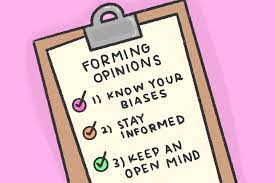
Informed opinions take effort. They aren’t handed to you. You build an informed opinion yourself. No one can give you an informed opinion, and distrust instantly anyone who tries.
Being informed takes work. You read. You listen. You watch. You think.
You cover all the sides of the argument, not just the ones you like.
You entertain the idea that you might be wrong.
When you do these things, you’ll find that your opinions change. They get more complicated. Fair enough; life is complicated. The soundbite opinions we’re fed are simplistic and reductive.

We’re out of the habit when it comes to questions. We hang out in echo chambers where being wrong doesn’t come up very often.
Don’t get me wrong – I like a good echo chamber as much as the next person. They’re comfortable. They don’t make us itch between our shoulder blades when a challenge is made to our determined and unsophisticated point of view. They don’t trigger guilt.
Echo chambers are nothing but good feedback (marred by the occasional troll.) Who needs to analyze a position when it’s getting likes? [i]
Being wrong stopped being something that happens as a part of life and has become a fate worse than death. It’s like losing. We treat loss as something that just shouldn’t happen. Error and loss are a sign of weak character. And changing an opinion is a fate worse than death.
We’d rather face the social media equivalent of pistols at dawn than revisit a conclusion we’ve drawn.
We hinge our reputations on everything we do, on every encounter, comment, and post. We’re not meant to live in this state of constant intensity. Every interaction should not hold the value of who we are as a person as the outcome.
At least in my opinion.
Life’s complicated. How odd that we keep trying to break it down into binary rules. There’s so much more to opinion than “right” and “wrong.” Most of the time.
Some suggest there are obvious and unbreakable rules.
Don’t kill other people.
Don’t steal.
Don’t lie.
Don’t cause any harm.
Walk lightly on the earth – it’s not yours, after all, you’re just borrowing it.
But even those get murky. What if someone attacks you first? Can you kill them then? What if you’re starving to death? Is it wrong to steal food if your children are dying? What if your husband will beat you if you speak the truth?
Not much in life is black and white, and if you find yourself acting and thinking along those lines, it’s time for a sit and a think.
We’ve become simple, and that’s not a compliment. A simple life, well, that’s great. I’m all for consuming less and having chickens. We think simply. We don’t demand more from the information providers. We’ve become creatures of the blurb and soundbite, and when things are harder to acquire, we quickly lose interest.
It’s too bad attention’s a muscle.
We’re a lazy species, most of the time.
Your opinion is what you think or believe about something. Opinion’s not synonymous with “fact” though some people treat them as one and the same.
Opinions are easy. We have thoughts about everything. Ask me about Tom Brady and I’ll gladly give you my two cents, despite never having seen him play, despite not following football, and with only the vaguest of understandings about “Deflategate.”
An informed opinion can be backed up. You have some degree of knowledge about the subject at hand.
The more you know, the more informed and expert your opinion (knowledge acquired via the soundbites of Twitter doesn’t count).
If your opinion is informed enough, you could be considered an expert. I’m an expert at almost nothing, but I’m at a solid 80% across a wide range of subjects.
An informed opinion should also be broad. Knowledge is integrative – bits of this inform bits of that.
~ My Uninformed and Personal Opinion.
[i] We used to use the term “troll” to label people who were abusive and nasty online, but it seems to me that the label has been extended of late and now is used to denote people who disagree.
 From Famine to Feast
I think it’s very important to know what we are talking about before saying it out loud, so yes, informed opinion is the need of the hour.
Also your words are really good in respect to this topic. Well written 🌻
LikeLiked by 1 person
Thank you.
LikeLiked by 1 person
When life was much simpler, I saw changing opinions as something to frown upon. You should stick by your convictions. I would get annoyed when kids would change their minds on something, depending on whom they were talking to just to stay liked. I still uphold this for adults who fall into that pattern.
However, if you change your opinion based on additional research (and then stick to it for a minute), then I am fine with it. I respect that. There ARE a lot of nuances.
Well said.
LikeLiked by 1 person
Thank you. I agree with what you said – people who change opinions with the wind (or with whoever is sitting next to them) are annoying.
LikeLiked by 1 person
I rarely offer my opinion on things I know little to nothing about. I stay silent in group conversations a lot–both because I have nothing of value to add and because I’m listening to learn. Like you, I’m a lifelong learner–I enjoy learning new things; however, changing any of my longstanding opinions practically takes an act of god. I have vague opinions about most things, which are all constantly changing with each new bit of information I receive on it, but those opinions that I’ve solidly formed and speak out on are usually much more grounded in research, fact, and firsthand knowledge–I admit that I may POSSIBLY be wrong, but it will be next to impossible to get this Taurus to back down from my own strong opinions.
On the flip side, I work in the legal industry where black and white simply doesn’t exist. I often intentionally jump onto the adverse side to poke holes in our own clients’ cases so we can strengthen our defense of them. As a result, I often see both sides of many situations and have a difficult time choosing between the two, since I often have opinions in common with both.
LikeLiked by 1 person
I think with really informed opinions, we are slower to change, if only because we acquire the information ourselves. I’m not one to be convinced by talking heads or headlines.
I always wished I’d studied debate. You pick up the “both sides” skill there as well. I admit I can be a bit dogmatic.
LikeLiked by 1 person
The “both sides” skill is dangerous when I’m feeling contrary with my partner. 🤣
LikeLiked by 1 person
😂😂😂
LikeLiked by 1 person